Western Airguns, Benjamin PCP Rifles and Big-Bore Airgun Guide
People searching for air guns near me or comparing air gun dealers near me increasingly look beyond conventional pellet rifles toward PCP platforms, compact bullpups, hunting configurations, and American-designed big-bore systems. Whether the search begins with airguns usa, air rifle dealers, air rifle online, or airguns online, understanding the major platforms, calibers, operating systems, and intended applications makes it easier to compare available models responsibly.
Western Airguns and Big-Bore PCP Platforms
Among modern PCP manufacturers, western airguns has attracted considerable attention for compact designs and larger-caliber platforms. Searches such as western air guns, western air gun, western rifles, western firearm, western firearms, and western arms are commonly associated with people researching the Western Airguns product family.
Popular models include the western rattler, western rattler air gun, and western rattler bullpup. Buyers researching larger calibers may also encounter the western rattler 357, 357 rattler, 357 air rifle, .35 cal air rifle, western rattler 45, and western big bore bushbuck 45. These searches generally relate to powerful PCP platforms designed around larger projectiles rather than conventional small-caliber recreational pellet rifles.
The term western rattler bullpup for sale is frequently used by shoppers comparing availability, while western rattler bullpup amazon may appear in searches from users attempting to determine whether the platform is offered through major marketplaces. Availability, shipping rules, age restrictions, and licensing requirements should always be verified for the buyer’s jurisdiction.
Another recognizable Western platform is the western mordax. Related searches include western mordax pcp, western airguns mordax, western mordax venom, mordax venom, mordax airgun, mordax air gun, and mordax air gun price. People using these phrases are generally researching specifications, configurations, pricing, and availability rather than a traditional spring-powered rifle.
The western sidewinder is another platform frequently associated with the brand. Search phrases include western sidewinder compact, sidewinder gun, sidewiner, sidewinder length, and even technical searches such as sidewinder k7a-00008 manual. Product dimensions, magazine systems, air-cylinder capacity, operating pressure, and manufacturer documentation should be checked against the exact version because specifications can vary.
For customers researching very large-caliber Western models, bush buck and bushbuck air rifle price are common search phrases. Big-bore platforms are sometimes described broadly as a big bore pellet gun, big air rifle, big game airgun, or big game air guns. Their intended use, permissible energy level, and legal hunting applications vary significantly between regions.
Bullpup and PCP Air Rifle Technology
A bullpup air rifle places much of the action behind the trigger, allowing a comparatively long barrel to be packaged into a shorter overall platform. This layout has become particularly popular with pcp guns, pcp rifle, and pcp air rifles because compressed-air cylinders and magazines can be incorporated into relatively compact designs.
A compressed air rifle stores high-pressure air and releases a controlled amount during each shot. This system differs substantially from a break barrel pellet gun, where the barrel is typically used to cock a spring or gas-ram mechanism.
People researching an accurate pellet rifle or long range air rifle often compare regulator performance, barrel quality, projectile consistency, trigger characteristics, stock fit, shot count, and optics compatibility. Accuracy depends on the complete system rather than power alone.
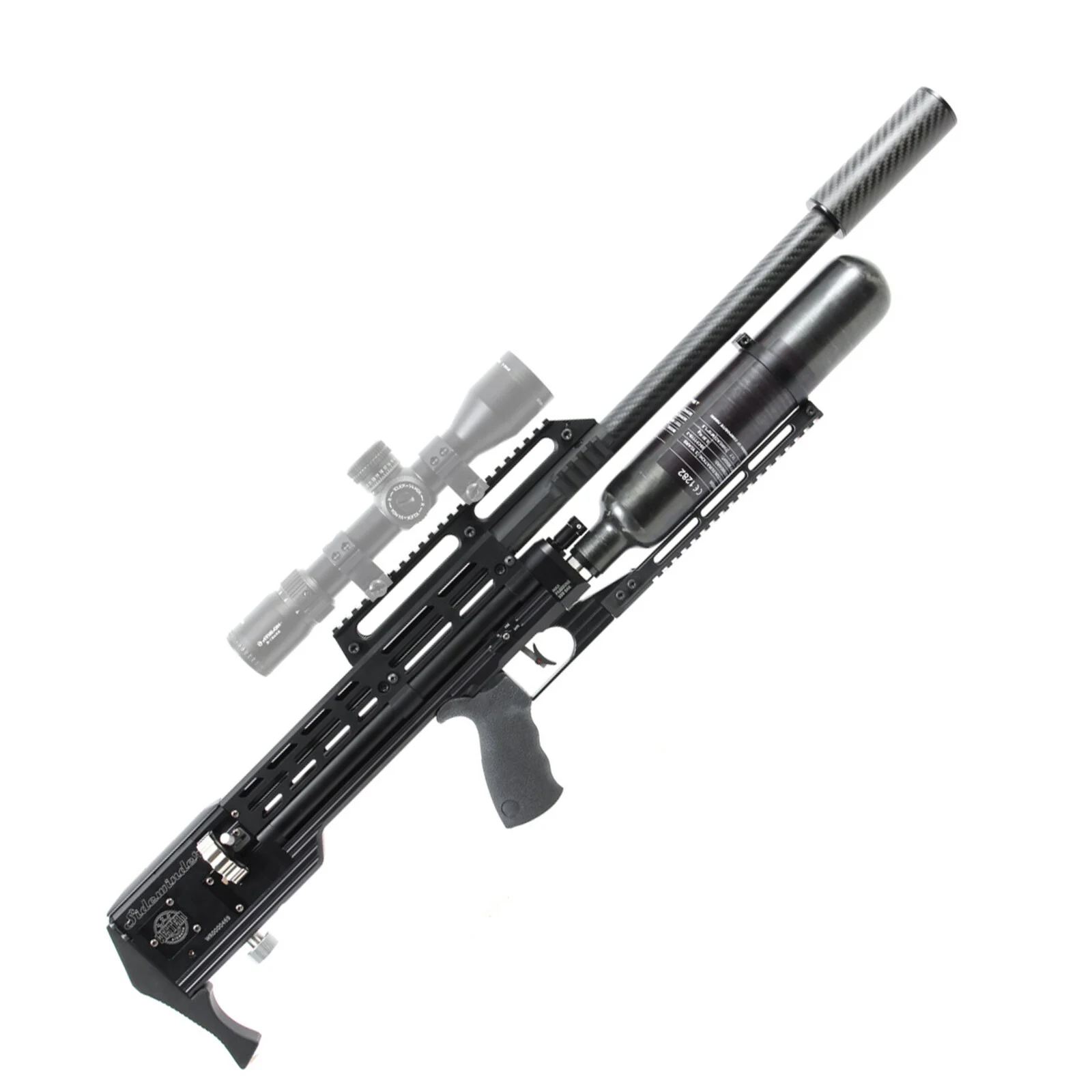
Some shoppers also search for a semi automatic pellet gun or full auto air gun. These terms describe different cycling mechanisms and should not be treated as interchangeable. Regulations governing semi-automatic or fully automatic air-powered platforms may also differ from regulations covering manually cycled rifles.
Search phrases such as lethal air guns and steel penetrating full auto airgun sometimes appear online, but airguns should never be treated as toys or casually tested against unsafe targets. High-energy models can cause severe injury and should be used only with suitable backstops, eye protection, safe handling procedures, and full compliance with local law.
People also ask where do bullets land when shot in air. Projectiles fired upward eventually return toward the ground, and their landing point cannot be safely predicted. For that reason, an airgun or firearm should never be discharged vertically or in any direction without a verified safe impact area and backstop.
Other Western-Style and Specialty Airgun Searches
A number of additional terms appear alongside Western Airguns searches, including serpent arms, venom arms, desert scorpion pistol, atlas airguns, and lindstradt air gun. Similar searches may also include edgun west, edgunwest, and ed gun west, which are spelling variations commonly entered by people researching EDgun-related products and U.S. availability.
Search terms such as az air guns can relate to retailers, regional airgun communities, or businesses associated with Arizona. Because similar names can refer to different organizations, buyers should verify the manufacturer, retailer, warranty provider, and exact product before ordering.
A double barrel air gun or shotgun air rifle represents another specialized category that differs considerably from the typical single-barrel PCP rifle. Likewise, searches for a western arms shotgun may refer to products from a different manufacturer than Western Airguns, so model identification remains important.
Benjamin Air Rifles and PCP Platforms
Benjamin has a long history in the airgun market, which is why searches for a benjamin air rifle, benjamin air rifles, benjamin pellet gun, and benjamin pellet remain common among recreational shooters and hunters.
One of the best-known PCP families is the benjamin marauder. Search variations include benjamin marauder pcp and benjamin marauder air rifle. The Marauder platform is often researched by users comparing PCP rifles for target use, recreational shooting, and lawful pest-control applications.
Another widely searched model is the benjamin bulldog, a larger-caliber PCP platform. Queries such as benjamin bulldog 457 20 joules may refer to specific regional configurations, energy-restricted versions, or product information. Because power specifications can differ by market, purchasers should verify the manufacturer’s specifications and applicable regulations.
The benjamin prowler represents another area of interest for users comparing more traditional air-rifle configurations. Meanwhile, benjamin air rifle 22 break barrel is frequently searched by shoppers specifically looking for .22-caliber break-barrel designs.
Older or heavily used rifles may lead owners to search for benjamin air rifle repair. Seal condition, valves, pressure systems, triggers, barrels, stocks, and other components should be inspected or serviced according to manufacturer recommendations, particularly when dealing with high-pressure PCP equipment.
Airbows, Arrow Rifles and Alternative Air-Powered Platforms
Not every compressed-air hunting platform uses pellets. Searches for air bow, airbow, air bow rifle, arrow gun, benjamin airbow, and benjamin bow refer to systems designed to propel arrows using compressed air.
These products differ fundamentally from ordinary air pellet gun systems and should be selected according to their intended purpose and applicable local hunting regulations. Buyers should also confirm compatible arrows, pressure requirements, filling equipment, optics mounting options, and manufacturer-recommended accessories.
Air Pistols and Hunting-Oriented Searches
An air rifle and air pistol can serve very different roles depending on caliber, energy, operating system, and regional law. Searches such as hunting air pistol, air pistols for hunting, and co2 pellet guns often involve very different products.
CO2-powered models typically use replaceable carbon-dioxide cartridges, whereas PCP pistols rely on pre-charged compressed air. Local regulations determine whether either type can lawfully be used for hunting.
The term m357 can also appear when shoppers research revolver-style air pistols or products carrying similar model designations. Because this phrase can refer to multiple items, checking the manufacturer’s full model number is important before selecting accessories or replacement components.
Additional Airgun Types and Search Categories
The broader airgun market includes everything from a basic bb gun rifle and traditional spring-powered designs to sophisticated regulated PCP systems. Some buyers search for a pellet gun with silencer, although suppressor, moderator, and sound-reduction laws vary significantly between jurisdictions.
Others look for a hunting air rifle, big game air guns, or other high-powered platforms. The appropriate caliber and energy level depend on local law, target species where hunting is legal, shooting distance, projectile selection, and manufacturer recommendations.
A search such as air gun for semi truck may refer to an air-powered accessory, cleaning tool, pneumatic device, or another product entirely rather than an air rifle. Clarifying the intended equipment category is therefore important before purchasing anything based solely on that phrase.american made air rifles.airrifle
Choosing Between Western, Benjamin and Other Airgun Platforms
Comparing products from western airguns, Benjamin, EDgun-related brands, and other PCP manufacturers requires more than comparing advertised power figures. Consider overall length, weight, caliber availability, magazine capacity, fill pressure, regulator design, shot count, trigger system, stock configuration, warranty coverage, parts availability, and manufacturer support.
A compact western sidewinder, larger western rattler, western mordax pcp, traditional benjamin marauder, big-bore benjamin bulldog, or another pcp air rifles platform may suit very different users and applications.
Responsible selection should therefore begin with the intended lawful use, followed by caliber, dimensions, power level, filling equipment, ammunition availability, service support, and local regulatory requirements. Whether someone begins their search with air guns near me, air gun dealers near me, air rifle dealers, or airguns online, careful comparison helps distinguish between recreational airguns, precision PCP rifles, hunting-oriented systems, specialty bullpups, and big-bore platforms.
Practical Use in Everyday Shooting and Field Work
Quiet practice sessions are supported when regulator pressure is lowered and lighter pellets are loaded. Consequently, backyard targets can be engaged without excessive report or unnecessary energy. A stable rest is recommended at first so that trigger press and follow-through can be learned before offhand work is attempted. Moreover, magazines can be swapped quickly so that several short strings are completed from a single fill. Inclusive use is encouraged: any legally entitled adult can begin at reduced power and increase output only after grouping and safety habits are established.
When neighbors or local noise rules must be respected, the velocity wheel is turned toward the lower end of its range. Therefore, pellets remain subsonic or only mildly supersonic, and the shrouded barrel helps keep the signature modest. Paper, reactive spinners, and small steel plates at modest distance are suitable first targets. After groups tighten, distance can be increased in small steps so that holdover and wind drift are observed rather than guessed.
Pest Control Around Buildings and Outbuildings
Humane pest work is performed best when a known energy band and a predictable point of impact are confirmed with a chronograph and a few test shots. Mid-range regulator settings are often chosen so that sufficient energy is delivered without wasting air on every shot. Semi-automatic fire is preferred for most pest situations because each shot can be aimed and a follow-up can be taken only if needed. Full-automatic fire is reserved for rare cases where multiple animals appear at once and local law permits that use.
Rats, pigeons, and similar small pests around barns or yards are typically engaged from a supported position. A bipod on the lower rail or a packed bag on a fence rail is used so that the first shot is placed accurately. Lights on the side rails can be fitted for dusk work where legal. Inclusive practice means that a second person can act as a spotter so that every shot is observed and no animal is left wounded. After a session, the rifle is made safe, the magazine is removed, and remaining air pressure is noted so that the next outing starts from a known fill.
Hunting Scenarios Where Lawful
Coyote-sized game and similar quarry, where hunting with air is legal and an appropriate certificate is held, are approached with heavier slugs and a higher regulator setting. Energy in the upper published band is selected only after confirmation that the projectile and distance produce ethical performance. A scope on the top Picatinny rail is zeroed at a practical hunting distance, and a few confirmation shots are fired from the same rest that will be used in the field.
Stalking is aided by the compact overall length and moderate weight. The rifle can be carried slung and brought to the shoulder without excessive bulk. Semi-automatic mode is used for the first shot and for a deliberate follow-up. Full-automatic mode is generally avoided on live game because control and shot placement suffer when the muzzle rises through a burst. Instead, a short, aimed pair can be produced by a brief trigger press if the selector is set to full-auto and the shooter is practiced—yet most ethical hunters keep the selector on semi.
Wind, angle, and animal movement are allowed for before the shot. After the animal is down, the rifle is made safe before approach. Inclusive hunting parties can assign spotting, ranging, and recovery roles so that no single person is left to manage every task alone. Local seasons, bag limits, and landowner permission remain mandatory; the rifle only supplies the means once those conditions are met.
Range Days, Zeroing, and Skill Building
Club and private-range sessions are used to map each caliber and power setting. A notebook or phone log is kept so that regulator pressure, wheel position, pellet or slug brand, and group size are recorded. Consequently, a “quiet practice” load, a “pest” load, and a “maximum lawful hunting” load can be reproduced later without guesswork.
Twenty- to fifty-yard groups are shot first from a bench. Once those groups are acceptable, unsupported sitting and kneeling positions are practiced so that field shots are not the first time the rifle is fired off a rest. Full-automatic strings are fired only at known-distance steel or paper after the area behind the target is confirmed clear. A magazine can be emptied in a few seconds; therefore, muzzle discipline and a firm hold are required so that shots stay on the backstop.
Trigger feel is learned in semi-auto before bursts are attempted. A light, usable trigger is already fitted, yet each shooter still needs time to avoid slapping the trigger during a string. Inclusive coaching is valuable: a more experienced partner can watch for flinch, cant, and premature magazine dumps so that habits are corrected early.
Semi-Automatic Versus Full-Automatic in Real Use
Semi-automatic fire is the default for accuracy work, pest control, and hunting. Each shot is released, the action cycles, and the next shot is available without a bolt or lever being worked. Follow-up shots are therefore fast while still being aimed.
Full-automatic fire is treated as a training and recreational tool. Short bursts of two or three shots can be produced with a brief press once the shooter has learned the timing. Long dumps are reserved for steel or large paper at close, controlled distance because group size opens as the muzzle moves. Air is consumed faster in full-auto, so bottle pressure is checked more often. Inclusive range rules should state when bursts are allowed so that every person on the line understands the plan.
Sound changes when the magazine runs empty. That change is used as a cue to stop the trigger press immediately so that dry cycling is limited. Magazines are then swapped and the chamber is verified before fire is resumed.
Pellets, Slugs, and Matching the Load to the Job
Lighter pellets at lower power are chosen for high shot count and for close, quiet practice. Mid-weight pellets at factory-style settings are used for general pest and mid-range target work. Heavier pellets and slugs at higher regulator pressure are reserved for longer shots and for larger legal quarry. The magazine depth is sufficient for most common slugs, yet overall length limits must still be observed so that feeding remains reliable.
A few brands should be tested rather than assumed. One projectile that groups well at 20 yards may open at 50 yards if speed is too high or too low. Chronograph readings and group measurements together decide the final load. Inclusive testing means that left- and right-handed shooters, and those who shoot from a bench versus from sticks, all confirm zero from the position they will actually use.
Supported, Offhand, and Awkward Field Positions
A bipod on the lower rail is used for prone and bench work. Packs, fence rails, and vehicle hoods (where safe and legal) serve as improvised rests. Offhand shooting is practiced because not every pest or hunting shot offers a rest. The compact length and balance of the platform help, yet dry-fire or empty-chamber practice with the safeties applied is still useful for building a steady hold.
Kneeling and sitting positions are rehearsed with the sling if one is fitted to the AR-style grip area. Side rails can carry a light for last-light work; the extra weight slightly changes balance, so a few confirmation shots are fired after any accessory is added. Inclusive setup includes adjusting grip panels or aftermarket furniture so that smaller or larger hands can reach the selector and magazine release without strain.
Weather, Maintenance Between Sessions, and Transport
Cold weather can change regulator behavior and velocity. Therefore, a short confirmation string is fired after the rifle has sat in the same temperature as the shooting area. Moisture is wiped from the bottle, rails, and magazine well before storage. Only clean, dry high-pressure air or nitrogen is used for fills; overfilling beyond 300 bar is never attempted.
Between outings, magazines are emptied and inspected. Rails are checked so that optics have not loosened. The two safeties are verified. For transport, the rifle is unloaded, magazines are separate, and a locked case is used in accordance with local law. Inclusive travel planning includes sharing fill-source locations and spare magazines so that a group day is not ended by one empty bottle.
Building a Repeatable Outing From Fill to Last Shot
A typical practical day can be structured as follows. The bottle is filled to a known pressure. Regulator setting and velocity wheel position are set to the planned load. Magazines are loaded with the chosen projectile. A brief confirmation group is fired at a safe distance. Then the intended work—practice, pest, or lawful hunting—is carried out in semi-auto unless a controlled burst drill has been planned. After the last shot, the magazine is removed, the chamber is checked, safeties are applied, and remaining bottle pressure is recorded.
That simple loop can be repeated by any responsible owner. Power can be raised or lowered for the next outing. Accessories can be added or removed. Caliber can be chosen at purchase to match the most common local task. What remains constant is deliberate use: aimed shots, known energy, clear backstops, and respect for the law and for everyone sharing the land or the range.
When those habits are followed, the platform is used as a precise, fast-handling PCP for practice, pest work, and lawful hunting rather than as a novelty. Shot placement stays first. Fire mode, magazine changes, and accessory lights stay in support of that goal. Inclusive, careful use turns a capable rifle into a tool that can be relied on from the first quiet backyard group to the last ethical shot of a legal season.
Frequently Asked Questions
Clear answers are provided below so that purchase, setup, and daily use can be planned with fewer surprises. Local law still overrides any general guidance. Therefore, a licensed dealer or the relevant authority should be consulted whenever energy limits, certificates, or hunting rules are in doubt.
What calibers are offered and how should one be chosen?
Three chamberings are commonly supplied: .22, .25, and .30. Trajectory and shot count tend to favor .22 for target work and smaller pests. A middle balance of energy and magazine capacity is offered by .25. Maximum published energy and heavier slugs are associated with .30 where that power is legal and needed.
Magazine capacity changes with caliber. Fifteen rounds are typically held in .22 and .25. Twelve rounds are typically held in .30. Inclusive choice means that intended quarry, local energy caps, and preferred projectile type are weighed together rather than a single “best” caliber being assumed for every shooter.
Is an FAC or similar certificate required?
Certificate requirements are set by muzzle energy and by national or regional law. In many jurisdictions, air rifles remaining at or below about 12 ft-lbs may be held without a firearm certificate, while higher energy requires the appropriate document. Because regulator pressure and a velocity wheel can be adjusted, output can sit in a low practice band or in a much higher hunting band.
Minimum settings can produce modest energy and a very large shot count. Mid “as shipped” settings often sit well above typical unlicensed limits. Maximum settings can reach the upper published figures for each caliber. Consequently, a certificate may be required once the rifle is tuned above the local unlicensed threshold. Legal status is never assumed from marketing energy numbers alone; the specific rifle in hand should be chronographed after any adjustment.
How is power changed in practice?
Two controls are used together. Regulator pressure is set so that a stable downstream band is maintained as bottle pressure falls. The velocity-control wheel is then used to fine-tune hammer strike and muzzle speed. Chronograph confirmation is recommended after every change.
Lower settings are chosen for quiet backyard work and high shot count. Mid settings are chosen for general pest and club use. Higher settings are chosen only when lawful hunting or larger pests require that energy. Inclusive setup includes writing the chosen regulator reading and wheel position in a log so that any user of the same rifle can repeat the load.
How many shots can be expected from a full fill?
Shot count is not a single figure. A 580 cc bottle filled to a maximum of 300 bar is the usual air source. At minimum power, hundreds of shots may be available in .22. At maximum power, the string may fall to a few dozen shots. Mid settings typically produce a long, usable regulated window measured in many magazines rather than a handful of shots.
Full-automatic fire consumes air faster than semi-automatic fire. Therefore, remaining bottle pressure is checked more often when bursts are practiced. Temperature, elevation, and projectile weight also affect the count. A personal log after the first few fills is more reliable than a brochure range.


Reviews
There are no reviews yet.