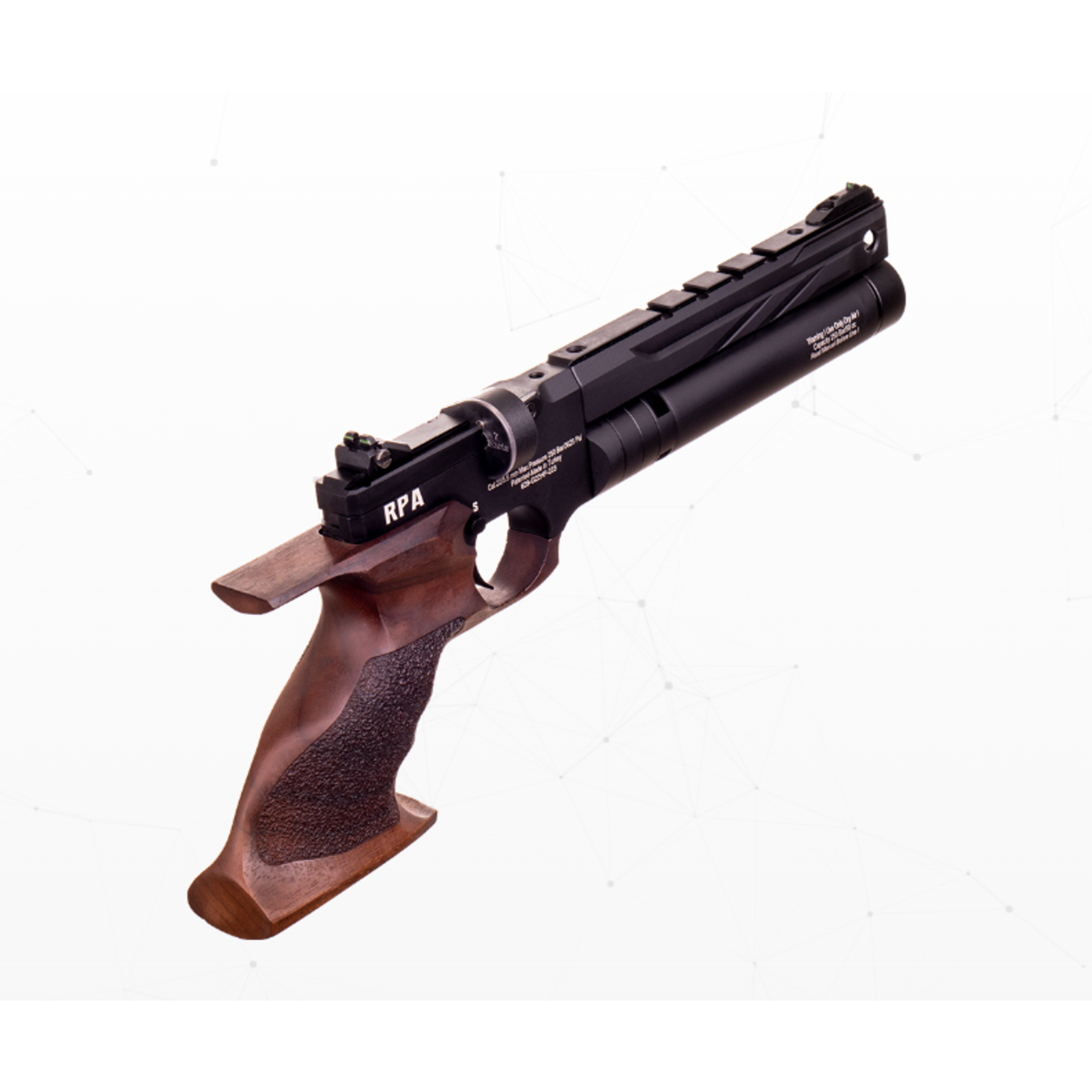
Reximex RPA PCP Pistol/Carbine
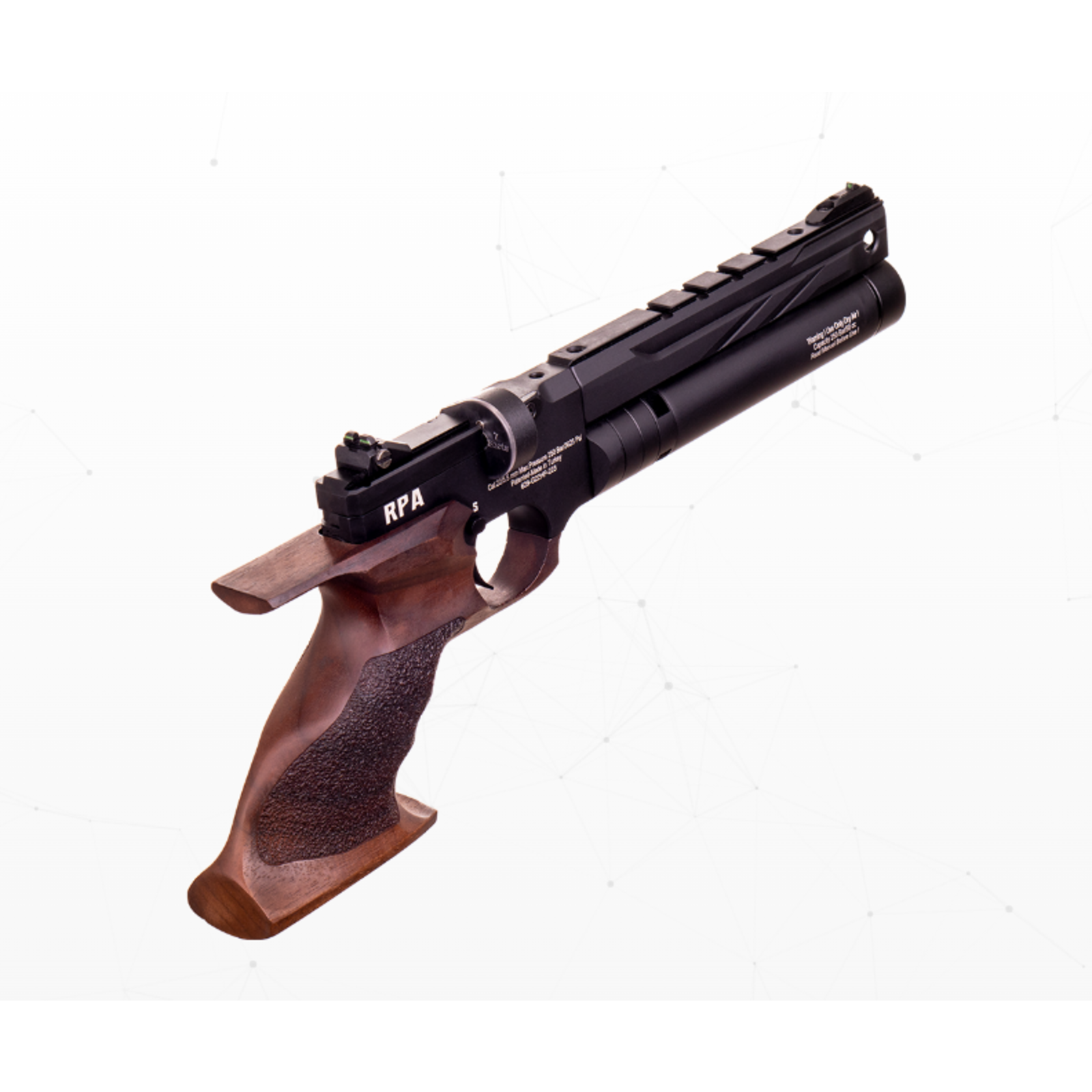
Versatility and regulated precision are combined in the Reximex RPA PCP Pistol/Carbine. Compact handling is delivered in pistol form, while added stability is provided when the platform is configured as a carbine. Consequently, target practice, plinking, and close-range pest control are supported by one adaptable system. Furthermore, consistent shot-to-shot performance is maintained by an integrated regulator, so point of impact remains predictable across a useful fill. Moreover, the design is appreciated by shooters who value portability without sacrificing control.
Precision Engineering That Supports Confident Shooting
A pre-charged pneumatic powerplant is employed, and air is stored in a removable 50 cc aluminum cylinder that is filled to 250 bar / 3,625 PSI. In addition, remaining pressure is displayed by a gauge at the cylinder end, so fill status is monitored at a glance. Subsequently, air is metered by the regulator so velocity stays consistent through the useful portion of the fill. As a result, groups remain tighter than unregulated pistols of similar size typically allow.
Sidelever cocking is used, and cycling is kept smooth for repeated strings. Meanwhile, a rifled 7.9-inch barrel is fitted, and pellet stability is improved for both .177 and .22. Equally important, a 1/2″ UNF threaded muzzle adapter is included, so a moderator can be attached when a quieter report is preferred. Therefore, backyard sessions and field use are both accommodated.
Highlights at a Glance
- Regulated PCP action is featured for consistent velocity
- Removable 50 cc cylinder is filled to 250 bar / 3,625 PSI
- Sidelever cocking is provided for smooth follow-up shots
- Fiber-optic front and rear sights are fitted and remain adjustable
- An 11 mm dovetail rail is included for optics
- A 1/2″ UNF muzzle adapter is supplied for a moderator
- Dual-role pistol and carbine configurations are supported
- Soft case, magazines, single-shot tray, and fill probes are included
Calibers, Power, and Practical Shot Count
Two popular calibers are offered. In .177, velocities up to approximately 610 fps are achieved with suitable pellets, and muzzle energy around 7 FPE is produced in typical unrestricted specifications. In .22, velocities up to about 515 fps are reached, and energy near 10.7 FPE is delivered. Consequently, paper punching, reactive targets, and small-game or pest work at modest distances are all within reach, provided local laws and ethical ranges are observed.
Optimal-velocity shot counts of roughly 55 in .177 and 40 in .22 are commonly reported when the cylinder is used between 250 bar and the regulator floor (often cited near 100 bar / 1,450 PSI). Therefore, a single fill supports an extended session before a swap or refill is required. Spare cylinders can be kept ready, so downtime is reduced. Additionally, magazine capacities of 9 rounds (.177) and 7 rounds (.22) are provided in pistol magazines, while larger rifle magazines (14 / 12 respectively on convertible kits) are supplied on many RPA/RP packages. A single-shot tray is also included for testing pellets or precision work.
Power figures vary by market. Lower-energy versions are produced for jurisdictions with legal limits, while higher-output versions are available where permitted. Local regulations should always be confirmed before purchase and use.
Pistol Handling and Carbine Stability in One Platform
A compact overall length of about 13 inches is maintained in pistol configuration, and weight stays near 1.98 lb. As a result, the RPA is easily carried and pointed for close work. Textured ergonomic grips—often Turkish walnut or colored laminate—are fitted, and a secure hold is encouraged for a wide range of hand sizes. An ambidextrous layout is used, so left- and right-handed shooters are both accommodated. A manual safety is present, and an adjustable two-stage trigger is found on many examples, allowing pull to be tailored.
When the detachable stock is fitted (on convertible RPA/RP packages), overall length extends to approximately 23.6 inches and weight rises modestly to around 2.2 lb. Consequently, a more stable sight picture is obtained, and effective range is extended for many users. A ridged rubber buttpad is typically included, and shoulder contact remains comfortable during longer strings. Optics on the 11 mm dovetail become especially useful in carbine form; two-piece adjustable rings are recommended if both rail sections are used, because the barrel-shroud rail sits slightly higher than the rear section.
Open fiber-optic sights remain usable in pistol mode: the front blade is adjustable for elevation and the rear for windage. For carbine use, a compact red-dot or low-power pistol scope is frequently preferred.
What’s Included and How the Platform Is Maintained
A protective soft case with foam cutout is supplied. Two magazines, a single-shot tray, and fill probes (male/female on many kits) are packed so the pistol can be used immediately after a proper fill. Spare O-rings and a manual are commonly included. Extra magazines and spare 50 cc cylinders are widely available, so readiness can be increased.
Routine care remains straightforward. The cylinder is unscrewed for filling or swapping. The regulator setting should be adjusted only according to the manufacturer’s instructions. A quality PCP fill source (hand pump, compressor, or scuba) and dry, clean air are recommended. Legal, safe handling practices—muzzle awareness, target identification, and secure storage—are essential for every owner.
Why the Reximex RPA PCP Pistol/Carbine Is Chosen
Value is delivered by combining regulated consistency, convertible form, and a complete accessory set at an accessible price. Accuracy at 15–25 yards is frequently praised when quality pellets (such as JSB Exact in matching weight) are used. Moreover, the platform remains light enough for all-day carry yet stable enough for more serious practice once the stock is attached. Inclusive design—ambidextrous grip, straightforward controls, and optional optics—means the RPA can be enjoyed by new and experienced shooters alike.
Responsible ownership is expected. Airgun laws, energy limits, and age restrictions differ by country and region; compliance is required. When those rules are followed, the Reximex RPA PCP Pistol/Carbine offers a compact, regulated, dual-role airgun that rewards careful shooting and regular practice.
The Reximex RPA PCP Pistol/Carbine is ready to be added to a well-equipped range bag or field kit whenever versatile, consistent PCP performance is needed.
Calibres, FAC Status, Power Output, and Accessories
Two widely used pellet calibres are offered on the Reximex RPA PCP Pistol/Carbine. Consequently, both precision target work and slightly heavier impact at modest ranges can be selected according to local rules and intended use. Furthermore, power delivery is shaped by market specification, regulator setting, and pellet choice, so legal limits and ethical shooting distances must be confirmed before the platform is used.
Available Calibres and Typical Performance
.177 (4.5 mm) and .22 (5.5 mm) are the standard chamberings. In .177, lighter pellets are driven at higher velocity, and flatter trajectories are produced for paper and reactive targets. In .22, heavier projectiles are preferred by many users when slightly more energy on target is desired. Moreover, magazine capacity changes with calibre: pistol magazines commonly hold nine rounds in .177 and seven rounds in .22, while larger rifle magazines supplied with convertible kits typically hold fourteen and twelve rounds respectively.
Velocity and energy figures vary by specification. In unrestricted or higher-output versions, approximately 610 fps and around 7 FPE are frequently cited in .177 with suitable 8.4-grain-class pellets. In .22, figures near 515 fps and about 10.7 FPE are commonly listed with 18-grain-class pellets. Therefore, consistent groups at 15–25 yards are routinely achieved when quality match pellets are used and the regulator is kept within its working band. Equally important, lower-energy versions are produced for markets with strict joule caps; those examples remain quieter and legal for more buyers while still delivering usable accuracy.
A regulated 50 cc cylinder filled to 250 bar / 3,625 PSI supplies the air. Subsequently, a useful shot string of roughly 55 rounds in .177 and 40 rounds in .22 is obtained at optimal velocity before pressure falls toward the regulator floor (often near 100 bar). As a result, a single fill supports an extended practice session. Spare cylinders can be kept charged, so interruption is minimised.
Calibre and Power Snapshot
- .177 (4.5 mm) is chosen for flatter trajectory and higher shot count
- .22 (5.5 mm) is selected when slightly greater pellet mass is preferred
- Pistol magazines of 9 / 7 rounds are supplied according to calibre
- Rifle magazines of 14 / 12 rounds are included on many convertible kits
- Approximate unrestricted figures: 610 fps / 7 FPE (.177) and 515 fps / 10.7 FPE (.22)
- Lower-joule versions are manufactured for licence-free markets
- Optimal-velocity strings of about 55 / 40 shots are typical per 250-bar fill
FAC, Legal Power, and Responsible Ownership
Firearm Certificate (FAC) requirements apply only where national law demands a certificate for airguns above a stated energy threshold. In the United Kingdom, air pistols above 6 ft-lbs and air rifles above 12 ft-lbs generally require an FAC. Consequently, many RPA units sold into the UK are supplied in sub-limit form unless an FAC version has been specifically ordered. In numerous EU markets, Category D or equivalent licence-free status is granted when muzzle energy stays below the local joule limit (commonly 7.5 J, 16 J, 20 J, or similar, depending on country). Therefore, the exact specification on the carton and proof marks must be checked against the destination country’s rules.
Inclusive, responsible use is expected of every owner. Age restrictions, transport rules, and permitted places of use differ widely. Moreover, power that is legal in one region may be restricted in another. Local legislation should always be verified before purchase, import, or first fill. When those conditions are met, the RPA remains a compact, regulated platform suitable for licensed and licence-free shooters alike.
Power is not user-adjustable in the same way as some full-size PCP rifles; the regulator is set at the factory or by a qualified technician. Hammer-spring tension can be altered on some examples, yet instructions must be followed exactly. Over-filling above 250 bar is never recommended. Safe storage, muzzle discipline, and positive target identification remain mandatory regardless of calibre or energy rating.

Accessories That Complete the System
A comprehensive accessory set is packed with the pistol so the first range session can begin promptly. A padded soft case with foam cut-outs protects the gun in transit. Two rotary magazines, a single-shot tray, and fill probes (male and female on many kits) are included. In addition, a 1/2″ UNF threaded muzzle adapter is fitted, allowing a compact moderator to be attached when a quieter report is desired.
Convertible RPA / RP packages add a detachable shoulder stock. Consequently, the same action can be used as a 13-inch pistol or as an approximately 23.6-inch carbine. A ridged rubber buttpad is usually present on the stock, and stability is improved for longer strings. Extra 50 cc cylinders are sold separately and thread on in seconds, so a second charged bottle can be carried. Additional magazines in both pistol and rifle lengths are widely available.
Optics are supported by an 11 mm dovetail rail. Fiber-optic open sights are already installed and remain adjustable for windage and elevation. When a red-dot or compact pistol scope is preferred, two-piece adjustable rings are advised because the forward rail section sits slightly higher than the rear. Moderators, spare O-rings, and quality fill sources (hand pump, portable compressor, or scuba adapter) complete a practical field kit.
Maintenance accessories stay simple: dry, clean air, periodic inspection of the cylinder O-rings, and manufacturer-approved lubricant where specified. Inclusive language and clear manuals help new and experienced users maintain the platform safely. When these items are kept together, the Reximex RPA PCP Pistol/Carbine is ready for consistent, regulated shooting in whichever calibre and legal power level has been selected.
Weihrauch Air Rifles, PCP Platforms, Spring-Piston Systems, and Related Airgun Terminology
Enthusiasts researching premium German airgun engineering frequently encounter models and search terms such as Weihrauch HW100X Karbine, Thumbhole PCP Air Rifle, hw35, h 45, german air rifle, accurate air rifles, hw97k, hw 70, hw35e for sale, hw40, weihrauch hw30, weihrauch hw80, weihrauch hw 95, hw100, hw 97k, hw35 air rifle, hw50 s, weihrauch hw45, weihrauch english, weihrauch hw98, weihrauch englisch, hw77 air rifle, weihrauch hw50s, compressed air rifles, air rifle makes, spring piston, what are air rifles, weihrauch hw44, air shot gun, sk x rifles, weihrauch hw50, hw30s, hw 30, what are air pistols, hw50, and rifles de aire.
Within the Weihrauch lineup, the Weihrauch HW77 air rifle is widely recognized as a traditional fixed-barrel underlever platform. Related terminology includes HW77 Green Laminate rifle, Weihrauch underlever air rifle, HW77 spring piston air rifle, Weihrauch HW77 for sale, and German precision air rifle. Researchers comparing versions may also encounter phrases such as buy Weihrauch HW77 Green Laminate online, Weihrauch HW77 Green Laminate price and specs, Weihrauch HW77 accuracy review, HW77 Green Laminate vs HW97 comparison, is Weihrauch HW77 good for beginners, precision shooting airgun, high quality German airguns, best price Weihrauch HW77, where to buy Weihrauch HW77, Weihrauch HW77 in stock, affordable premium air rifle, and top rated underlever air rifle.
Technical comparison searches commonly include Weihrauch HW77 vs HW97, HW77 vs break barrel air rifle, best Weihrauch air rifles, most accurate air rifle for target shooting, air rifle with low recoil, durable air rifle for outdoor use, and reliable air rifle for long term use. These phrases generally reflect interest in operating systems, mechanical durability, handling characteristics, consistency, and the differences between fixed-barrel underlever designs, break-barrel rifles, and PCP platforms.
Other Weihrauch-related terminology includes air pistols, hw100 airgun, weihrauch hw95, weihrauch hw 30, weihrauch hw90, hw 44, hw 40, hw 98, and weihrauch hw100. The HW100 family represents the PCP side of Weihrauch’s catalog, while models such as the HW30, HW50, HW80, HW90, HW95, HW97, and HW98 are associated with spring-powered or gas-ram-style sporting airgun platforms depending on the specific model and configuration. By contrast, the HW44 is commonly discussed as a PCP air pistol.
The broader airgun market also includes search terminology connected with alternative PCP manufacturers and modern platforms. Examples include 25 karma, pcp bb gun, karma eq air rifle, karma red panda, panda guns, full auto pcp, karma sls compact, air karma, red panda hat, eq air, karma sls, eq magazine, air pcp, and karma airguns. These terms may refer to specific products, product families, accessories, community terminology, or unrelated search phrases that appear alongside airgun research.
Reximex is another name frequently encountered in PCP discussions. Related search phrases include reximex airguns, reximex rp, reximex throne gen 2, reximex mito, reximex rpa, sbs12, reximex mitos, reximex lieva, reximex accura pcp air rifle, and reximex throne gen2. Model naming can vary slightly between retailers, regions, and search listings, which explains variations such as “Throne Gen 2” and “Throne Gen2” or “Mito” and “Mitos.”
Airgun research also involves understanding velocity and energy. Searches such as fps to joules calculator, fps to ft lbs, and airgun calculator relate to converting projectile velocity and mass into kinetic-energy measurements. These calculations are commonly used for technical comparison, range evaluation, regulatory research, and understanding how different compressed-air or spring-powered platforms perform within their intended specifications.
More general discovery terms can include gunseek and yivli av tüfeği, alongside broader international phrases such as rifles de aire. Because airgun terminology varies considerably between English, German, Spanish, and Turkish-speaking markets, researchers may encounter several different naming conventions for comparable sporting, target, and recreational airgun platforms.
Taken together, terms ranging from Weihrauch HW100X Karbine and Thumbhole PCP Air Rifle to HW77 Green Laminate rifle, spring piston, compressed air rifles, karma airguns, and reximex airguns illustrate the diversity of modern airgun technology. Weihrauch remains particularly associated with German engineering, fixed-barrel underlever rifles, traditional spring-powered designs, precision PCP systems, and air pistols, while Karma and Reximex represent additional names encountered when comparing contemporary PCP platforms and associated airgun technology.
Practical Use Scenarios
Everyday shooting needs are met by a compact, regulated sidelever platform that can be carried as a short pistol or steadied as a light carbine. Consequently, backyard practice, formal paper work, pest management at modest ranges, and travel-friendly training sessions are all supported when local laws and safe backstops are observed. Furthermore, inclusive handling—ambidextrous grip, modest weight, and straightforward controls—allows a wide range of shooters to participate comfortably.
Backyard Plinking and Informal Practice
Short sessions after work are easily organised because overall length stays modest in pistol form and weight remains under two pounds for most users. Therefore, a folding table, a pellet trap, and a few reactive targets can be set up quickly. Moreover, the regulator keeps velocity consistent through a useful portion of the fill, so point of impact does not wander as the cylinder is depleted. As a result, tin cans, spinner targets, and printed circles at 10–20 yards become reliable feedback tools rather than frustrating guesswork.
Open fiber-optic sights are already fitted, so optics are not required for casual strings. Meanwhile, a compact red-dot can be added when tighter groups are desired. Equally important, a threaded muzzle adapter permits a small moderator; neighbour-friendly volume is then maintained in suburban gardens where local noise rules apply. Subsequently, fifty or more well-regulated shots in the smaller calibre (or about forty in the larger) can be fired before a cylinder swap is needed. Spare bottles that have been pre-filled keep the session flowing.
Inclusive practice is encouraged. New shooters can begin from a supported rest; more experienced hands can move to standing or kneeling positions as confidence grows. Safety glasses, a designated firing line, and a solid backstop remain essential. When those habits are followed, informal plinking becomes a repeatable, low-stress activity rather than a once-a-month event.
Typical Backyard Setup
- A pellet trap or thick rubber backstop is placed against a safe berm
- Distances of 10–20 yards are marked with inexpensive stakes
- Reactive targets and printed circles are rotated to maintain interest
- A moderator is fitted when neighbourhood quiet is required
- A second charged cylinder is kept ready so the session is not interrupted
Paper Targets and Skill Development
Formal grouping work is supported by the same regulated action. Consequently, five- and ten-shot groups at 15–25 yards can be used to evaluate pellet brands and seating technique. Furthermore, the single-shot tray included with most kits allows individual pellets to be loaded when magazine feed is being tested or when extra-long slugs are tried. Accuracy is therefore isolated from magazine variables.
A two-stage trigger that can be refined on many examples helps the shooter learn a consistent break. In addition, the sidelever is cycled with a short, repeatable motion, so follow-through is not disturbed by a long cocking stroke. When the detachable stock is fitted, a more rifle-like hold is adopted and wobble is reduced. As a result, the same action that feels lively as a pistol becomes a stable trainer for sight picture and trigger control.
Inclusive coaching is straightforward. Left- and right-handed participants use the same controls. Lighter shooters appreciate the low recoil and modest hold weight. Older shooters often prefer the carbine configuration for the extra contact point. Progress can be logged with simple group-size notes rather than expensive electronics, although a chronograph remains useful when regulator behaviour is being confirmed.
Weather is managed rather than avoided. Light wind is read with flags or grass; the relatively short barrel is less affected than a long rifle at these distances. Rain is handled by wiping the action and keeping the fill port capped. Therefore, skill-building need not wait for perfect conditions.

Pest Management at Ethical Distances
Where local law permits airguns for pest control, the platform is used at short to moderate ranges against small, legally designated species. Consequently, a precise first shot is favoured over volume of fire. The larger calibre is often selected when extra pellet mass is desired; the smaller calibre is chosen when a flatter trajectory and higher shot count matter more. Ethical distance, a clear backstop, and positive identification of the target remain non-negotiable.
A carbine stock improves first-round hits from improvised field positions—kneeling behind a fence, sitting on a bucket, or using a vehicle door as a rest. Meanwhile, the pistol configuration is reserved for tight spaces such as outbuildings or dense shrubbery where a longer gun cannot be swung. A compact optic or the existing fiber-optic sights are zeroed at the expected engagement distance, typically well inside 30 yards for humane results.
Quiet operation is assisted by a moderator and by the inherent report of a mid-power PCP. Neighbours and livestock are therefore less disturbed. Spare cylinders and extra magazines are carried in a small pouch so a second opportunity is not missed because the gun is empty. After the session, the cylinder pressure is checked and the gun is stored unloaded, with the safety applied, in a locked container.
Responsible users confirm every local ordinance before the first pest shot is taken. Inclusive language on the range or in the field—clear commands, shared safety briefings—keeps mixed groups coordinated.
Travel, Club Days, and Shared Sessions
Compact dimensions make the platform easy to pack. A soft case with foam cut-outs protects the action, magazines, and fill probes in a car boot or under a bench at the club. Consequently, a complete kit travels without occupying the space of a full-length rifle. At the destination, the stock can be attached or left off according to the day’s plan: pistol-only for a 10-metre line, carbine for a 25-yard informal match.
Fill logistics stay simple. A hand pump, a portable compressor, or a pre-charged spare cylinder covers most club and field days. The on-board gauge shows remaining pressure at a glance, so mid-session decisions are informed rather than guessed. Inclusive club use is helped by the modest report (especially with a moderator) and by the fact that both experienced and novice members can share the same zeroed gun after a brief safety talk.
Longer travel days benefit from the removable cylinder. One bottle can be left at home charged while another travels; the action itself stays light. Hotel or campsite rules must still be respected—many venues prohibit even airguns. When permission is granted, a short evening session at a safe distance keeps skills fresh.
Field and Travel Checklist
- Charged spare cylinder and fill probe are packed
- Magazines and single-shot tray are stored in labelled pouches
- Moderator and compact optic (if used) are protected from knocks
- Local transport and range rules are confirmed in advance
- Eye and ear protection are issued to every participant
Training New Shooters and Mixed-Ability Groups
Low felt recoil and a clear sight picture make the platform suitable for introductory sessions. Therefore, first-time participants can focus on stance, sight alignment, and trigger press rather than fighting a heavy spring or a loud report. The instructor can stand close because the action is short. Furthermore, the manual safety and visible pressure gauge give concrete teaching points.
Progressive drills are easy to design. Supported shots from a bench come first; standing and kneeling follow. Magazine changes and cylinder swaps become part of the lesson so students leave able to run the gun independently. Inclusive groups—youth under supervision where legal, adults returning after a long break, shooters with limited upper-body strength—are accommodated by the light weight and ambidextrous layout.
Conversion between pistol and carbine mid-session demonstrates how hold and sight picture change with configuration. Consequently, students learn that equipment choice is a tool, not a fashion statement. All activity remains under the same safety rules: muzzle awareness, loaded-chamber discipline, and a designated safe direction.
Maintenance Habits That Support Reliable Use
Practical reliability is preserved by simple routines. Dry, clean air is used at every fill. The cylinder O-rings are inspected periodically and replaced when flattened or cracked. After dusty field days the action is wiped and the fill port is capped. A drop of manufacturer-approved lubricant is applied only where specified; over-oiling is avoided.
Storage is planned. The gun is left uncocked, safety on, cylinder pressure noted, and locked away from unauthorised access. Magazines are emptied. Inclusive households post clear rules so every resident understands that the compact PCP is treated with the same respect as any other airgun.
When these habits are kept, the platform remains ready for the next backyard hour, club evening, or carefully planned pest outing. Consistent regulation, modest size, and a complete accessory set turn occasional shooting into a sustainable, enjoyable practice that can be shared across experience levels and physical abilities—always within the law and always with a safe backstop.
Frequently Asked Questions
Common questions about a compact, regulated sidelever PCP that can be used as a short pistol or as a light carbine are answered below. Consequently, buyers, new owners, and experienced shooters can plan legal use, filling, accessories, and daily handling with fewer surprises. Furthermore, inclusive language is used so participants of different experience levels and physical abilities can find clear guidance. Local laws always take precedence over general descriptions.
Power, Calibres, and Legal Status
Which pellet sizes can be used?
Two standard pellet diameters are chambered. Therefore, both a flatter-shooting lighter option and a slightly heavier option for modest-range work are available. Magazine capacity changes with diameter: the smaller size typically feeds nine rounds from a pistol magazine, while the larger size typically feeds seven. Larger rifle-style magazines supplied with many convertible kits hold more rounds of each size. Quality match pellets of the correct head size are recommended so feeding and accuracy remain consistent.
How much power is produced, and is a certificate required?
Energy output depends on the specification sold in each market. Unrestricted examples commonly deliver mid-single-digit foot-pounds in the smaller calibre and low-double-digit foot-pounds in the larger calibre. Lower-joule versions are manufactured for jurisdictions with strict limits. Consequently, a Firearm Certificate is required only where national law sets a threshold that the particular example exceeds. In many regions the platform is sold in a licence-free configuration. Proof marks, the carton label, and local statutes must be checked before the first fill. Inclusive ownership means every user confirms the rules that apply at home and at any destination.
How many consistent shots are obtained from one fill?
A 50 cc cylinder filled to 250 bar supplies a useful regulated string. Approximately fifty-five shots at optimal velocity are typical in the smaller calibre and about forty in the larger calibre before pressure approaches the regulator floor. Therefore, an afternoon of paper or plinking can often be completed on a single bottle. Spare cylinders that have been pre-charged keep a session from being interrupted. Shot count varies with pellet weight, ambient temperature, and exact regulator setting.
Configuration, Handling, and Sights
Can the same action be used as both a pistol and a carbine?
A detachable stock is supplied with convertible kits. As a result, overall length stays near thirteen inches in pistol form and extends to roughly twenty-four inches when the stock is fitted. Weight remains modest in both configurations. The pistol layout is preferred for tight spaces and quick pointing; the carbine layout is preferred when a steadier sight picture is needed. The stock is attached or removed without tools on most examples.
Are open sights included, and can optics be mounted?
Fiber-optic front and rear sights are fitted from the factory and remain adjustable. An 11 mm dovetail rail is also present. Consequently, a compact red-dot or a low-power pistol scope can be added. Two-piece adjustable rings are advised if both rail sections are used, because the forward section sits slightly higher than the rear. Inclusive use is helped by the fact that iron sights work immediately while optics remain optional.

Is the platform suitable for left-handed shooters?
An ambidextrous grip and a sidelever that can be operated by either hand are provided. Therefore, left-handed participants are not required to purchase a special version. Safety location and magazine insertion should still be practised until the motions become automatic.
Filling, Accessories, and Daily Use
What is needed to fill the cylinder?
A compatible fill probe is included. A hand pump, a portable compressor, or a scuba adapter rated for 250 bar can be used. Dry, clean air is essential. Over-filling above the marked maximum is never recommended. The gauge at the front of the cylinder shows remaining pressure at a glance. Inclusive households post a simple fill checklist so every authorised user follows the same steps.
Which accessories arrive in the box?
A padded soft case, two rotary magazines, a single-shot tray, and fill probes are commonly packed. A 1/2″ UNF muzzle adapter is also supplied so a compact moderator can be attached. Convertible kits add the detachable stock. Extra cylinders, extra magazines, and spare O-rings are sold separately and thread or clip on in seconds.
Can a moderator be fitted, and how quiet is the report?
The included adapter accepts a 1/2″ UNF moderator. Consequently, backyard and suburban use becomes more neighbour-friendly where local noise rules allow. The unmoderated report is generally described as medium. Exact loudness depends on pellet, power specification,


Reviews
There are no reviews yet.