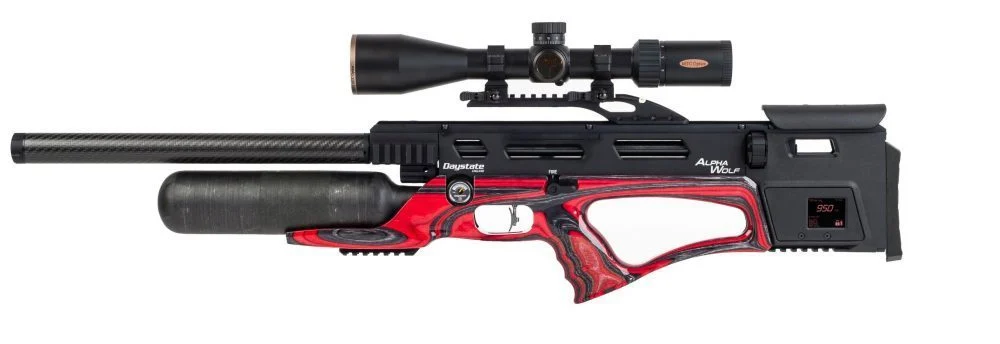
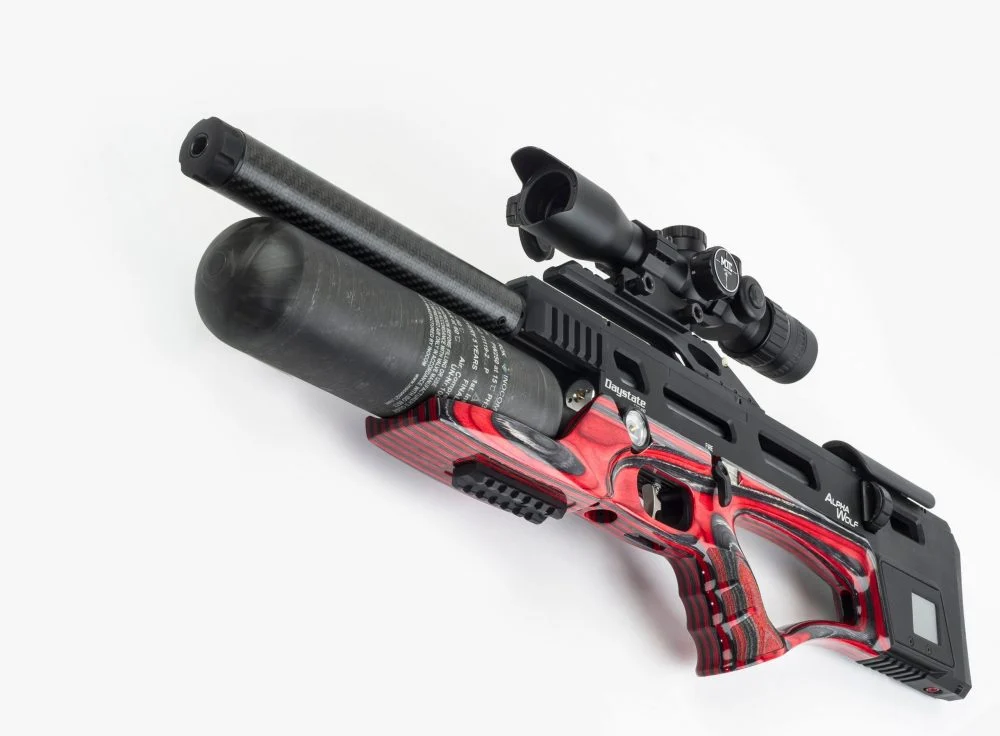
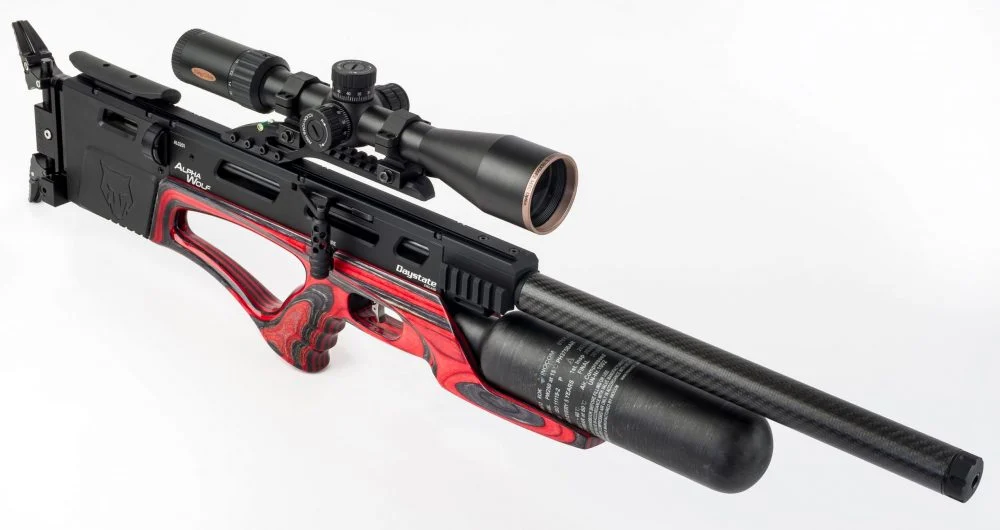
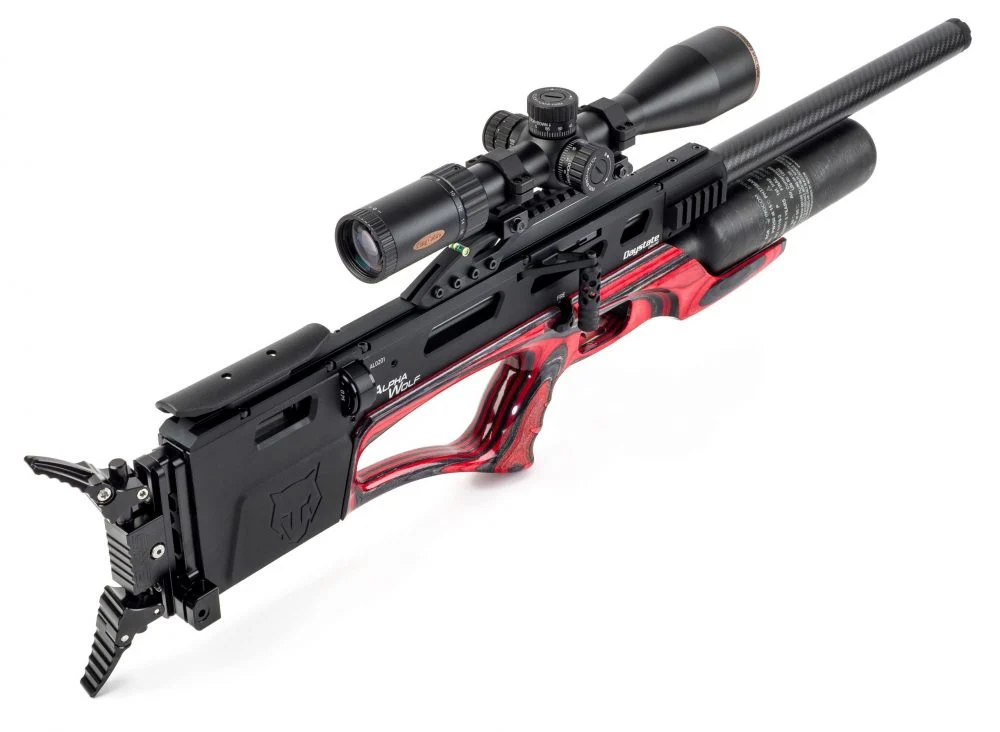
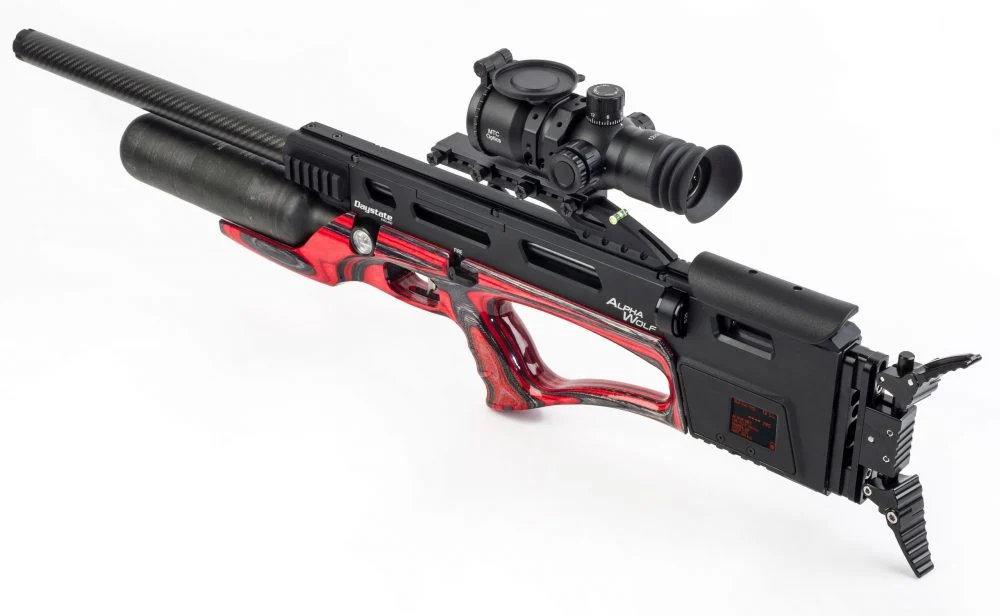
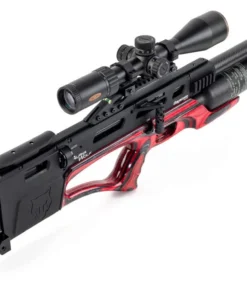
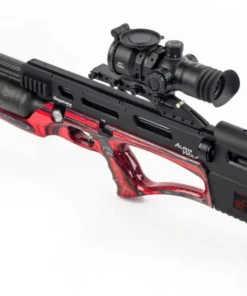
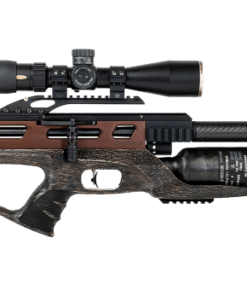
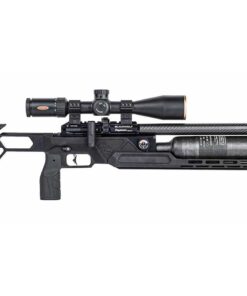
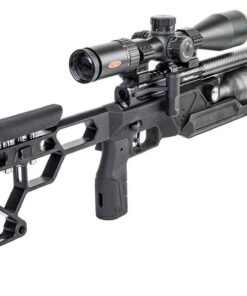
Precision Performance Is Unlocked by the Daystate Alpha Wolf
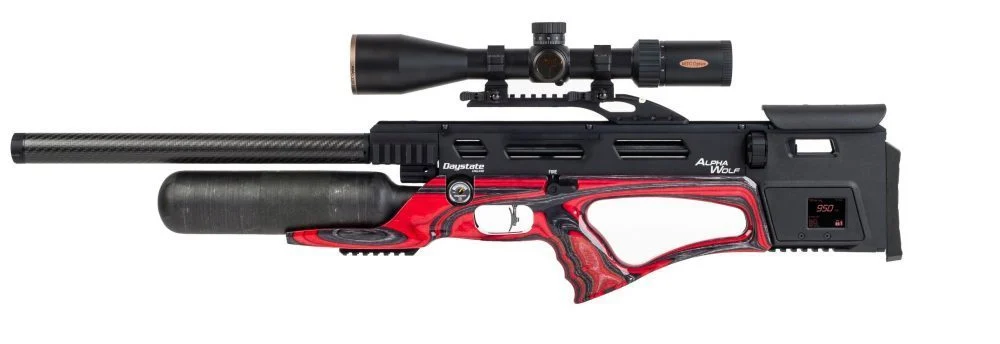
Uncompromising electronic control is delivered by the Daystate Alpha Wolf, and a new standard in programmable PCP design is therefore established for hunters, field target competitors, and precision shooters alike. A sculpted laminate stock is paired with a compact bullpup chassis, after which handling, balance, and long-session comfort are improved for left- and right-handed users. Meanwhile, future-proof electronics are integrated so that power, velocity, and ammunition profiles can be refined without a workshop visit. Consequently, consistent shot strings are produced even when conditions, pellet weight, or caliber are changed.
Furthermore, a carbon-fiber 480cc bottle is fitted beneath the barrel, and a maximum fill of 240 bar is supported. As a result, generous shot counts are achieved at both sub-12 ft/lb and high-power FAC settings. In addition, a Huma-Air regulator is employed so that pressure remains stable from the first pellet to the last usable shot. Thereafter, an onboard chronograph (on many configurations) is used so that real-time velocity can be monitored and stored.
How Advanced Velocity Technology Is Applied
Touch-screen programming is provided on the left side of the action, and pellet weight, caliber, barrel length, and desired velocity are entered by the shooter. Recommended regulator pressure and hammer dwell are then suggested by the AVT system, after which those values can be accepted or finely adjusted in microseconds. Moreover, presets can be saved so that different ammunition types are recalled in seconds. Likewise, optional Windows synchronization via a DTD adaptor is supported, and firmware updates can therefore be applied as Daystate releases new algorithms.
Core Features Are Highlighted for Every Daystate Alpha Wolf Build
A reversible side lever is installed so that cocking effort remains light for either hand. Simultaneously, a fully adjustable electronic trigger is offered, and pull weight, stage length, and blade position can be tailored to individual preference. An AR15-style isolation lever is used as a manual safety, and the electronics are isolated whenever the rifle is set to safe. Additionally, an adjustable cheek piece and butt pad are included so that length of pull and eye alignment can be set for any stature.
Highlighted listings that define the platform:
- Action: electronically controlled, multi-shot PCP with programmable AVT
- Barrel: Lothar Walther A.R.T. polygonal design with quick-change capability
- Regulation: Huma-Air regulator plus fast-flow valve and large plenum
- Air supply: 480cc carbon bottle, fill pressure up to 240 bar (3,480 psi)
- Cocking: reversible side lever for inclusive left- and right-hand use
- Trigger: electronic release, adjustable for weight, stage, and blade
- Safety: manual electronic isolation with AR15-type lever
- Magazines: self-indexing, 13-shot (.177), 11-shot (.22), 10-shot (.25), 8-shot (.30); dual-magazine magnetic pairing is supported
- Stock: ambidextrous laminated birchwood with alloy chassis, adjustable cheek and pad
- Rail: movable Picatinny optic rail with anti-cant bubble on many editions
- Accessories: M-Lok / Picatinny points, ½” UNF moderator thread, optional 0dB silencer and PRS upgrades
Consequently, a single rifle can be adapted from woodland pest control to long-range FAC hunting without a second purchase. Nevertheless, local laws and FAC requirements must always be observed before any high-power configuration is selected.
Calibers, Power Levels, and Shot Economy Are Matched to the Task
Standard and high-power formats are offered. On the compact 17-inch barrel configuration, overall length of approximately 722 mm and an unscoped weight near 3.35 kg are recorded. By contrast, the 23-inch HP barrel extends overall length to about 842 mm while weight remains close to 3.55 kg. A longer Performance/Smart barrel option near 711 mm is also listed on current Daystate specification tables.
Power bands that are commonly published include up to about 20 ft/lb in .177 and 45 ft/lb in .22 on standard setups, with HP figures rising toward 31–37 ft/lb in .177, 61–78 ft/lb in .22, 67–81 ft/lb in .25, and 95–115 ft/lb in .30 depending on barrel and Smart/Performance variant. Meanwhile, several hundred regulated shots at 12 ft/lb are typically available from a full 240-bar fill, whereas high-energy FAC strings are shorter but still efficient thanks to the regulator. Therefore, range sessions and hunting days can be planned with fewer bottle changes.
Because barrels and pellet probes can be swapped, a legal sub-12 rifle can later be converted where regulations allow. However, probe, magazine, and software caliber settings must all be matched before the first shot is taken.
Field Use Is Supported by Compact Handling and Quiet Delivery
Compact overall length is achieved by the bullpup layout, so movement through hides, vehicles, and woodland is simplified. In addition, a threaded shroud is provided so that a moderator can be fitted and report can be reduced for pest control. Moreover, dual magazines can be staged magnetically, after which 22 shots in .22 or 26 shots in .177 can be fired before a reload is required. As a result, follow-up opportunities are preserved when quarry is active.
Accuracy at 25–50 yards is repeatedly documented in independent tests, and single-hole groups are often produced when quality pellets or slugs are used and the AVT profile is correctly set. Likewise, consistency of only a few feet per second across a string is commonly reported once regulator pressure and hammer dwell have been dialed in. Therefore, holdover and wind calls become more predictable for every shooter on the firing line.
Inclusive fit is further supported by the ambidextrous stock and reversible lever. Consequently, clubs, families, and mixed-handed teams can share one platform without awkward conversions.
Responsible Ownership and Conversion-Ready Value Are Built In
A hard case, fill probe, magazine, and optic rail are typically supplied with a new rifle. Thereafter, third-party PRS furniture, bipods, and silencers can be added because multiple accessory rails are already present. Existing Delta Wolf owners can also be accommodated through official conversion components on some editions, so an earlier electronic platform is not left behind.
Legal compliance remains the shooter’s responsibility. Sub-12 and FAC power must be confirmed against local regulations, and secure storage is required whenever the rifle is not in use. Battery charge for the LiPo pack must be maintained, and the action must be switched on only when a safe shot is intended.
Why the Daystate Alpha Wolf Is Chosen by Serious Shooters
World-class regulation, a match-grade barrel, and software that can be updated are combined in one compact rifle. Furthermore, caliber flexibility is retained without a second action. In addition, an engaging laminate aesthetic is offered so that the rifle looks as refined as it shoots. Conversion-focused buyers therefore receive a platform that can grow from plinking and HFT practice into high-power hunting as skills and licenses develop.
Ready-to-order configurations of the Daystate Alpha Wolf are selected when programmable consistency, inclusive handling, and long-term upgrade paths are required. Precision is then placed in the hands of every responsible shooter who demands more than a fixed-power PCP.
Calibres, FAC Ratings, Power Output, and Accessories Are Configured on the Daystate Alpha Wolf
Versatile calibre choice is built into the Daystate Alpha Wolf so that target work, pest control, and high-power hunting can be served by one electronic platform. Standard and high-power formats are offered, after which legal energy limits can be matched to local rules. Meanwhile, barrel kits, probes, magazines, and software profiles are changed together so that consistency is preserved. Consequently, inclusive use by left- and right-handed shooters is supported across every listed calibre.
Furthermore, FAC-rated output is available where a certificate is held. In contrast, sub-12 ft/lb settings are retained for jurisdictions in which a licence is not required. Therefore, responsible ownership is encouraged before any high-energy profile is selected.
How Calibre Options Are Assigned Across Standard and HP Builds
Four calibres are listed for the Daystate Alpha Wolf family. On compact standard rifles, .177 (4.5 mm) and .22 (5.5 mm) are commonly supplied with a 430 mm (17 in) barrel. By comparison, HP and Performance/Smart configurations add .25 (6.35 mm) and .30 (7.62 mm) when a longer 600 mm (23 in) or 711 mm (28 in) barrel is fitted. Moreover, a quick-change barrel system is employed so that a different tube can be fitted after a single rear fastener is released.
A matching pellet probe must then be installed. Likewise, the correct magazine and AVT calibre setting must be selected on the touchscreen. As a result, feeding and velocity algorithms remain aligned. A single-shot tray is also supplied on many packages so that regulation or slug testing can be completed without a rotary magazine.
Highlighted calibre and magazine listings:
- .177 (4.5 mm): 13-shot magazine; dual-magazine pairing for 26 shots before a reload
- .22 (5.5 mm): 11-shot magazine; dual-magazine pairing for 22 shots
- .25 (6.35 mm): 10-shot magazine on HP builds
- .30 (7.62 mm): 8-shot magazine on HP builds
- Loading system: self-indexing, magnetically paired magazines plus single-shot option
- Barrel lengths typically listed: 430 mm standard, 600 mm HP, 711 mm Performance/Smart
- Overall length typically listed: about 722 mm, 842 mm, or 1041 mm depending on barrel
Thereafter, software presets can be stored for each calibre so that pellet weight and regulator advice are recalled in seconds.
FAC Status, Legal Energy, and Published Power Bands Are Explained
Legal classification is determined by muzzle energy in the destination country. In the United Kingdom, energy at or below 12 ft/lb is generally treated as unlicensed for air rifles, whereas higher output requires an FAC. Elsewhere in the EU and beyond, different joule limits apply. Consequently, the Daystate Alpha Wolf must be ordered and set in accordance with local law.
Published factory bands vary by barrel and electronics package. On standard 17-inch setups, energy up to about 20 ft/lb in .177 and 45 ft/lb in .22 is often quoted, while several hundred regulated shots at a 12 ft/lb club setting are commonly available from a 240-bar fill of the 480 cc carbon bottle. On HP 23-inch rifles, figures near 31–37 ft/lb in .177, 61–78 ft/lb in .22, 67–81 ft/lb in .25, and 95–115 ft/lb in .30 appear across Daystate specification tables and independent tests. Meanwhile, shot count falls as energy rises, yet the Huma-Air regulator still keeps velocity variation tight.
In addition, Advanced Velocity Technology is used so that hammer dwell, voltage, and regulator pressure can be refined. On Smart variants, simpler percentage power steps are provided instead of full microsecond tuning. Nevertheless, a separate chronograph is recommended whenever an FAC profile is changed, because displayed values must be confirmed on paper for compliance.
Inclusive practice is supported when a club-legal 12 ft/lb profile is saved beside a hunting FAC profile. Therefore, the same rifle can be shared among family members or club mates after the correct preset is loaded and the safety isolation lever is verified.
Power Delivery, Regulation, and Fill Practice Are Linked to Accessories
A 480 cc carbon-fibre bottle is fitted on the main Alpha Wolf and HP models, and a maximum fill of 240 bar (3,480 psi) is specified. A smaller 300 cc bottle is used on some compact Shadow editions so that carry weight is reduced. Fill access is hidden beneath a magnetic cover ahead of the trigger guard, after which a probe-style coupler is inserted. As a result, field top-ups remain clean.
A fast-flow valve and large plenum feed the Huma-Air regulator. Consequently, first-to-last shot consistency is maintained when the correct regulator pressure for calibre and pellet weight has been set. Battery charge for the 11.1 V LiPo pack must also be maintained, because the electronic trigger and display will not fire if power is isolated or depleted.
Highlighted accessory and upgrade listings for the Daystate Alpha Wolf:
- Fill kit: extended quick-coupler probe, magnetic port cover
- Optics interface: movable Picatinny rail, anti-cant bubble on many editions, 3° cant available on some rails
- Sound reduction: ½” UNF thread, optional 0dB / BRK moderator
- Support gear: AimGrip or PRS bipod points, M-Lok and additional Picatinny sections
- Stock fit: adjustable cheek piece, adjustable butt pad / Gecko-style pad on later editions
- Data tools: optional DTD adaptor for Windows synchronization and firmware updates
- Calibre kits: spare Lothar Walther A.R.T. barrels, matching probes, extra magazines
- Carry and protection: factory hard case on typical packages
- Third-party options: Precision Rifle Systems furniture and other aftermarket rails
Moreover, existing Delta Wolf owners can be offered conversion components on selected programmes, including a laminate stock set and updated firmware. Likewise, Safari, Blue Special, Carbon, Shadow, and Smart finishes may be chosen so that aesthetics match intended use without a change to the core electronic action.
Because accessories alter balance and point of impact, zero must be confirmed after a moderator, bipod, or rail shift is added. In the same way, a new barrel length requires a fresh AVT profile and a chronograph check before FAC energy is assumed.
Conversion-focused buyers are therefore given a platform on which calibre, legal power, and accessory fit can be expanded over time. Precision is then retained when every change is documented, tested, and stored as a named preset on the Daystate Alpha Wolf.
Daystate, FX Airguns, PCP Rifles, Accessories and Precision Airgun Equipment
For enthusiasts researching premium PCP platforms, accessories, replacement components, and precision shooting equipment, the modern airgun market offers an extensive range of options from brands such as Daystate and FX. Searches for daystate blackwolf, daystate redwolf, delta wolf, huntsman daystate, daystate alpha wolf, wolf delta, day state, and daystate delta wolf frequently come from shooters comparing electronic PCP technology, ergonomic designs, premium construction, and sophisticated firing systems. Traditional styling also remains important, which is why terms such as stock walnut, safari stock, dima stock, rimfire stocks, and stock replacement continue to attract buyers who value both appearance and practical fit.
Among electronically controlled PCP rifles, the daystate alpha wolf, daystate blackwolf, daystate redwolf, and daystate delta wolf are commonly associated with advanced regulation, refined shot management, and a highly consistent firing cycle. Searches such as what is a delta wolf, what is a delta wolf, delta wolf meaning, deltaw, blackwolf, red alpha wolf, alpha red wolf, model alpha gun, model alpha gun, and electronic wolves often reflect buyers trying to understand how Daystate’s electronically managed rifles differ from conventional mechanical PCP systems. Other searches, including daysta, wolf gun, wolverine gun, wolveriner, daystate wolverine sapphire, daystate wolverine sapphire, and wolfpack armory wolverine, demonstrate the broad interest surrounding Wolf-branded and Wolverine-related sporting platforms.
Small ergonomic components can make a substantial difference to comfort and handling. A rifle butt pad, rubber butt, rubber butt pad, and butt pad rifle accessory can improve shoulder contact, while a bradley cheek riser can help support a more consistent head position. Likewise, enthusiasts may research gecko grips, a cocking ball, short cocking, an index pin, pin magazine, lock timing, and lock time when learning about rifle ergonomics, cycling characteristics, and replacement components. Searches for buddy bottle cover and buddy bottle cover also remain relevant for shooters who want to protect external air cylinders from cosmetic wear during transport or field use.
Magazine compatibility is another frequent consideration. Users may search for a 177 magazine, mag 177, 25 magazine, 5.0 mm pellets, 177 pellets types, slug pellet, or a general pellet rifle when comparing ammunition formats and magazine configurations. Pellet selection should always match the manufacturer’s recommended caliber and specifications for the rifle being used. A well-matched magazine and suitable ammunition can support reliable feeding and consistent performance without unnecessary mechanical stress.
PCP equipment relies on compressed air, so searches such as air rifle compressed air, air gun pc, air gun, and air guns are commonly connected with understanding pre-charged pneumatic systems. Owners also frequently search for a pcp o ring kit because seals form an important part of maintaining an air-tight pneumatic system. Maintenance should follow manufacturer-approved procedures, especially for high-pressure components, regulators, cylinders, and valves.
Sound-moderation accessories form another major category. Common search terms include air gun suppressor, air gun suppressors, airgun moderator, air rifle moderator, 0db, 0db moderator, 0 db moderator, 0 db moderator, 0 db moderator, 0 db moderator, and hogan decimeater silencer. Thread-related searches include silencer thread adapter, thread protector rifle, and muzzle thread protector. Compatibility depends on barrel threading, caliber, applicable law, and manufacturer specifications, so owners should verify all requirements before purchasing or fitting any muzzle accessory.
Mounting systems have also become increasingly important as modular fore-ends and accessory rails become more common. Searches for an mlok to picatinny rail adapter, best m-lok to picatinny rail adapter, m-lok to picatinny adapter, picatinny m lok adapter, and picatinny bag rider usually come from shooters wanting greater flexibility when mounting supported accessories. The best adapter is generally one that matches the rifle’s rail specification, uses quality hardware, fits securely, and avoids unnecessary bulk.
Sling-related searches are equally common. Buyers frequently look up how to put a gun sling on a rifle, how to put a rifle sling on, how to install a rifle sling, riffle sling, rigle sling, how to put sling on rifle, installing a rifle sling, and attaching a sling to a rifle. A compatible sling can improve carrying comfort and transportation, but attachment points should always be checked against the rifle manufacturer’s recommendations to avoid damage to the stock or mounting hardware.
The alpha wolf barrel and accessories such as an ats tuner may also interest precision-focused users researching how different rifle configurations are designed. Similarly, terms such as weatherby vanguard trigger adjustment appear in broader shooting-related searches, although trigger systems differ significantly between platforms and should be serviced or adjusted only according to the applicable manufacturer’s safety instructions. Another unusual search phrase, how to put extinguisher call back together, is unrelated to PCP rifle servicing and should be treated according to the specific extinguisher manufacturer’s maintenance guidance rather than general airgun information.
For buyers comparing premium European PCP equipment, daystate redwolf price and daystate redwolf price are common commercial-intent searches. Pricing can vary depending on caliber, stock type, configuration, region, dealer, and included accessories. People may also search fx airgun dealer near me when looking for authorized retailers, parts support, servicing, or warranty assistance.
FX Airguns remains another major name in the PCP market. Popular searches include fx impact m3 .22cal air rifle. 600mm barrel, fx impact m3, fx impact mk3, fx m3 airgun, fx m3, impact m3, and fx impact m3 air rifle. Price-focused searches such as fx impact m3 precio, fx impact m3 precio en usa, and fx impact m3 price indicate strong buyer interest in comparing regional pricing and available configurations. The modular design philosophy associated with the FX Impact family makes it especially attractive to experienced PCP users who prioritize adjustability, ergonomics, accessory compatibility, and high-quality construction.
Potential buyers also encounter less common search phrases such as griffin gun, unfend, black snood, red bodywarmer, and can wolverine go on planes. Airline transport rules for sporting equipment and compressed-air components can differ substantially between carriers and countries, so travelers should always check current airline, airport, customs, and destination regulations before making travel arrangements. Likewise, terms such as 3.55kg in lbs may appear when buyers compare rifle weight specifications across metric and imperial listings.
Whether someone is researching the daystate alpha wolf, daystate blackwolf, daystate redwolf, huntsman daystate, wolf delta, an fx impact m3, or another premium pellet rifle, the most important purchasing factors remain intended use, caliber compatibility, overall weight, stock ergonomics, magazine design, air-cylinder capacity, manufacturer support, and accessory compatibility. Premium PCP ownership is best supported by appropriate maintenance, manufacturer-approved components, secure storage, responsible handling, and compliance with all local laws and transport requirements.
Practical Field Scenarios Are Built Around Everyday Shooting
Real-world use is planned around compact handling, programmable power, and regulated consistency rather than around a single named model. A short bullpup layout is carried through woodland, farm buildings, and club ranges, after which the same electronic action is re-profiled for a different pellet or legal energy limit. Consequently, one platform is shared by pest controllers, hunters, and target shooters when local rules and safe backstops are observed.
Furthermore, left- and right-handed users are accommodated by a reversible side lever and an ambidextrous stock. Inclusive sessions are therefore possible for families, clubs, and mixed-handed teams. Meanwhile, a touchscreen profile is saved for each task so that guesswork at the firing point is reduced.
Woodland Pest Control Is Conducted from Short Lanes
Movement between trees is simplified because overall length remains modest even when a 17-inch barrel is fitted. A moderator is attached to the half-inch thread, after which muzzle report is lowered for close work on rabbits, squirrels, and similar quarry where such use is lawful. In addition, a 12 ft/lb profile is loaded for jurisdictions that require it, and a heavier FAC profile is reserved only where a certificate and land permission are already held.
Quiet approach is favoured. As a result, the rifle is carried muzzle-down or slung close until a clear shot is presented. A dual-magazine pair is staged magnetically so that a second string can be started without a pocket search. Thereafter, the empty magazine is retained by the magnets while the fresh one is slid into battery.
Holdover is kept simple when a known pellet and a stored velocity are used. Moreover, an anti-cant bubble on the rail is checked before the shot so that groups are not thrown by a tilted reticle. Wind at the lane edge is read last, and the shot is released only when a safe backstop is confirmed.
Field checks that are completed before the first pest-control shot:
- Land permission and legal energy status are verified
- Battery charge and regulator pressure are confirmed on the display
- Correct calibre, probe, and magazine are matched
- Moderator and zero are confirmed after any accessory change
- Backstop, quarry identification, and follow-up plan are agreed
Consequently, humane first-shot placement is given priority over rapid fire.
Farm Buildings and Night Work Are Managed from Tight Corners
Barns, feed stores, and yards demand a short overall length. Therefore, the compact configuration is preferred, and a lightweight Shadow-style bottle may be chosen when carry fatigue must be reduced. A thermal or night-vision optic is mounted on the movable Picatinny rail, after which eye relief is set with the adjustable cheek piece.
Low light changes trigger feel. An electronic release is used so that pull weight can be lightened without a mechanical rebuild. Meanwhile, the isolation lever is kept on safe until the rifle is shouldered and the target is identified beyond doubt. Report is again controlled with a moderator so that remaining quarry is less likely to scatter.
Shot count on a 12 ft/lb setting is typically high enough for a full evening of rat work from a 240-bar fill. Nevertheless, a spare charged bottle is carried on longer nights because temperature drop can change displayed pressure. After each string, the magazine count on the screen is glanced at so that a dry click is avoided.
Inclusive night teams rotate the rifle because length of pull and comb height can be reset in seconds. As a result, junior or shorter shooters are not forced into an adult stock position.
Club Range Practice Is Used to Prove Profiles Before the Field
Zeroing is completed from a bench before hunting profiles are trusted. A known pellet weight is entered on the display, after which recommended regulator pressure is accepted or trimmed. Ten-shot strings are then fired and compared with an external chronograph whenever FAC energy must be documented.
Group size at 25 and 50 yards is recorded for each ammunition type. Likewise, slug profiles are tested from a single-shot tray before a rotary magazine is used. Variation of only a few feet per second is expected once the Huma-style regulator and hammer dwell have been settled. Therefore, holdover charts can be written with confidence.
HFT and field-target practice benefit from the same consistency. Kneeling and standing positions are used because the bullpup balance sits close to the trigger. In addition, the side lever’s short stroke is cycled without breaking cheek weld, so follow-up targets on a timed course are engaged more cleanly.
A club-legal 12 ft/lb preset is stored separately from any FAC hunting preset. Consequently, the rifle can be signed in at a club that forbids high power, then returned to a hunting profile at home after the energy is rechecked.
FAC Hunting on Open Ground Is Planned Around Energy and Ethics
Where a firearm certificate and lawful quarry are in place, higher energy in .22, .25, or .30 is selected. A 23-inch or longer barrel is typically fitted so that heavier pellets or slugs are driven efficiently. Trajectory flattens, yet shot count from the 480 cc bottle falls, so a hunting day is planned around fewer, better-placed shots rather than volume fire.
Wind calls become more important as distance increases. A stable regulator helps, but the projectile still drifts. Therefore, a rangefinder and a practiced dope card are used together with the stored velocity. Follow-up shots are available from the paired magazines, yet the first shot is treated as the ethical shot.
Transport between permissions is completed with the bottle either fitted or removed according to the owner’s routine. The action is isolated, the chamber is shown clear, and the rifle is cased. Inclusive hunting parties brief every member on energy setting, because a guest must not fire an FAC profile by accident.
Travel, Vehicles, and Hides Are Handled with Compact Storage
A factory hard case is used for vehicle travel. Overall length near 72 cm on the short barrel version allows the case to sit across a rear seat or in a modest boot. Meanwhile, spare magazines, a fill probe, and a small battery charger are packed in the same lid pocket so that a forgotten item does not end the day.
Inside a hide, the extended forend lip gives a resting point on sticks or a bag. Multiple accessory rails accept a bipod only when the lane is static; for reactive work the bipod is left off so that the rifle can be lifted quickly. A quiet cocking stroke is valued when birds or small mammals are close.
Temperature swings inside a vehicle can affect displayed pressure and battery life. After arrival, the rifle is allowed to settle, the screen is checked, and a fouling shot is fired into a safe bank if regulations and the landowner allow it. As a result, the first live quarry shot is not also the first cold shot of the day.
Shared Use, Coaching, and Inclusive Fit Are Organised on One Platform
Length of pull and comb height are adjusted so that a new shooter is not fighting the stock. The electronic trigger is lightened for a coach-supervised session, then returned to a hunting weight afterwards. Furthermore, the reversible lever is swapped when a left-handed guest arrives, and the change is reversed before the rifle is stored.
Coaching language stays inclusive. Sight picture, breathing, and follow-through are explained without assuming gender, age, or prior military experience. A single-shot tray is used for first groups so that magazine indexing is learned later. Thereafter, the dual-magazine system is introduced once safe muzzle control is habitual.
Club armoury storage follows local rules. Batteries are charged on a schedule, firmware is updated when a DTD adaptor and official files are available, and each stored profile is labelled by calibre and energy, not by a person’s name alone, so that any authorised user can select the correct setting.
Session flow that keeps shared use safe:
- Isolation lever is confirmed before the rifle is passed
- Profile name, calibre, and energy are read aloud from the screen
- Magazine capacity for that calibre is set so the counter is honest
- After shooting, the action is cleared and the battery state is noted
- Stock and lever laterality are returned to the house default
Consequently, the next person inherits a predictable rifle rather than a surprise.
Weather, Maintenance Between Outings, and Seasonal Changes Are Anticipated
Rain is managed by keeping the touchscreen and fill port covered until needed. The magnetic fill shroud is wiped before a probe is inserted so that grit is not pushed into the valve. After a wet day, the exterior is dried, the moderator is removed and emptied of moisture if the design allows it, and the rifle is stored muzzle-down or as the maker advises.
Cold weather reduces battery performance. A spare charged pack is therefore carried in an inner pocket. Hot weather can raise bottle pressure after a fill; filling is stopped at the marked 240-bar limit and is not topped past it when the bottle later warms in the sun.
Seasonal quarry changes invite a profile change rather than a new rifle. Spring rabbit work at modest energy is stored beside an autumn FAC slug profile. Pellet batches are labelled because a different head size can alter both grouping and the velocity the software expects. A brief chronograph check at the start of each season is treated as routine, not as optional tinkering.
O-rings, probes, and magazine seals are inspected on a calendar, not only after a failure. Likewise, rail screws and stock bolts are checked after travel. A loose rail changes zero more often than a worn barrel does.
A Full Day From House to Permission Is Walked Through in Order
Morning preparation is completed at home. Battery level is read, the intended profile is selected, and magazines are loaded with the pellet that matches that profile. The case is packed with moderator, probe, spare seals, notes, and eye and ear protection. Legal documents for FAC use, where required, are placed with the rifle, not left in another bag.
On arrival, permission is confirmed with the landholder. Lanes and backstops are walked. Wind and light are judged. The rifle is uncased, isolated, then powered, and the screen is compared with the written plan. A fouling shot or two is fired if it is safe and permitted. Zero on a known mark is confirmed at a distance that matches the first likely shot.
During the outing, energy and shot counter are glanced at after each magazine. Quarry is identified, the safety is moved only on the shoulder, and the shot is taken or declined. Declined shots are treated as success when the angle is poor. Follow-up is immediate when a strike is uncertain, provided a safe line remains.
Evening close-down is as deliberate as the start. The chamber is cleared, magazines are emptied or bagged, the bottle pressure is noted, and moisture is removed. Profiles are left on the legal setting that will be needed next, or they are returned to a default 12 ft/lb club setting so that an early range trip cannot start over-powered by mistake.
Conversion-minded owners add a bipod, a different rail height, or a second barrel kit only after that same full-day routine has been proved with the standard setup. Accessories are then introduced one at a time so that any zero shift can be attributed. In this way, practical use stays predictable for every shooter who shares the rifle, and precision in the field is produced by preparation rather than by hope.
Frequently Asked Questions Are Answered for Everyday Ownership
Common buying and ownership questions are collected below so that legal energy, calibre choice, electronics, and field use can be planned before a purchase. Inclusive language is used throughout, because left- and right-handed shooters, new owners, and experienced hunters share the same platform. Focus topics such as programmable power, FAC limits, magazines, regulation, and accessories are covered in the answers, while a branded model name is omitted from the wording itself.
Furthermore, local law always overrides a handbook figure. Consequently, a dealer or licensing desk should be consulted whenever energy, transport, or hunting permission is uncertain.
Power, Legal Status, and Intended Use Are Clarified
Is a licence required before this electronic PCP can be owned?
A licence is required only when muzzle energy exceeds the limit set by the destination country. In the United Kingdom, 12 ft/lb is the usual air-rifle threshold, after which an FAC is needed. Elsewhere, joule limits differ. Therefore, the rifle must be ordered and set to match the buyer’s paperwork. A club-legal profile can be stored beside a higher FAC profile, provided the higher setting is never selected where it is unlawful.
How is sub-12 output kept consistent for club and woodland use?
A regulated 12 ft/lb profile is created on the touchscreen after pellet weight and calibre are entered. Recommended regulator pressure is then accepted or trimmed, and a chronograph check is completed so that the printed energy can be shown if a club or landowner asks. Meanwhile, several hundred shots from a 240-bar fill are typically available at this modest setting, so a full evening of pest control can be finished without a bottle change.
When is an FAC profile appropriate?
An FAC profile is appropriate only after a certificate, lawful quarry, and a safe backstop are already in place. Higher energy in .22, .25, or .30 is then selected, often with a 23-inch or longer barrel. Shot count falls as energy rises. As a result, hunting days are planned around fewer, better-placed shots rather than volume fire.
Can the same rifle be used for HFT, plinking, and hunting?
Yes, separate presets can be stored for each task. A 12 ft/lb target profile is loaded at the club, after which a hunting profile is recalled at home once energy has been rechecked. Inclusive club use is supported when the default stored setting is the legal club limit, so a guest cannot fire an FAC string by accident.
Calibres, Barrels, Magazines, and Ammunition Are Explained
Which calibres are commonly listed?
Four calibres are commonly listed: .177, .22, .25, and .30. Standard compact builds are most often supplied in .177 and .22 with a 17-inch barrel. High-power builds add .25 and .30 when a longer barrel is fitted. A matching probe, magazine, and software calibre must travel together whenever a tube is swapped.
How is a barrel change completed?
A rear fastener is released, after which the barrel is withdrawn and the correct probe is fitted. The new length and calibre are entered on the display. A fouling string and a chronograph check are then fired before any FAC claim is trusted. Consequently, a legal woodland rifle can later become a longer-range hunting rifle where regulations allow.
What magazine capacities are used?
Capacities of 13 shots in .177, 11 in .22, 10 in .25, and 8 in .30 are typical. Dual magazines can be paired magnetically so that 26 shots in .177 or 22 shots in .22 are available before a reload. A single-shot tray is also supplied on many packages for slug testing and for regulation work.
Are pellets and slugs both supported?
Both are supported when the software weight and a suitable barrel profile are set. Factory algorithms are often developed around the maker’s own ammunition, yet other quality match pellets are widely used. A new batch should still be grouped and chronographed, because head size and skirt hardness change both point of impact and displayed velocity.
Highlighted feeding and barrel points:
- Rotary, self-indexing magazines are used for hunting strings
- Magnetic pairing is used to double a string without a pocket search
- A single-shot tray is used for slugs and for zero work
- Quick-change barrels require a matching probe and a fresh preset
- Moderator threads are usually ½” UNF behind a shroud


Reviews
There are no reviews yet.