Daystate, FX Airguns, PCP Rifles, Accessories and Precision Airgun Equipment
For enthusiasts researching premium PCP platforms, accessories, replacement components, and precision shooting equipment, the modern airgun market offers an extensive range of options from brands such as Daystate and FX. Searches for daystate blackwolf, daystate redwolf, delta wolf, huntsman daystate, daystate alpha wolf, wolf delta, day state, and daystate delta wolf frequently come from shooters comparing electronic PCP technology, ergonomic designs, premium construction, and sophisticated firing systems. Traditional styling also remains important, which is why terms such as stock walnut, safari stock, dima stock, rimfire stocks, and stock replacement continue to attract buyers who value both appearance and practical fit.
Among electronically controlled PCP rifles, the daystate alpha wolf, daystate blackwolf, daystate redwolf, and daystate delta wolf are commonly associated with advanced regulation, refined shot management, and a highly consistent firing cycle. Searches such as what is a delta wolf, what is a delta wolf, delta wolf meaning, deltaw, blackwolf, red alpha wolf, alpha red wolf, model alpha gun, model alpha gun, and electronic wolves often reflect buyers trying to understand how Daystate’s electronically managed rifles differ from conventional mechanical PCP systems. Other searches, including daysta, wolf gun, wolverine gun, wolveriner, daystate wolverine sapphire, daystate wolverine sapphire, and wolfpack armory wolverine, demonstrate the broad interest surrounding Wolf-branded and Wolverine-related sporting platforms.
Small ergonomic components can make a substantial difference to comfort and handling. A rifle butt pad, rubber butt, rubber butt pad, and butt pad rifle accessory can improve shoulder contact, while a bradley cheek riser can help support a more consistent head position. Likewise, enthusiasts may research gecko grips, a cocking ball, short cocking, an index pin, pin magazine, lock timing, and lock time when learning about rifle ergonomics, cycling characteristics, and replacement components. Searches for buddy bottle cover and buddy bottle cover also remain relevant for shooters who want to protect external air cylinders from cosmetic wear during transport or field use.
Magazine compatibility is another frequent consideration. Users may search for a 177 magazine, mag 177, 25 magazine, 5.0 mm pellets, 177 pellets types, slug pellet, or a general pellet rifle when comparing ammunition formats and magazine configurations. Pellet selection should always match the manufacturer’s recommended caliber and specifications for the rifle being used. A well-matched magazine and suitable ammunition can support reliable feeding and consistent performance without unnecessary mechanical stress.
PCP equipment relies on compressed air, so searches such as air rifle compressed air, air gun pc, air gun, and air guns are commonly connected with understanding pre-charged pneumatic systems. Owners also frequently search for a pcp o ring kit because seals form an important part of maintaining an air-tight pneumatic system. Maintenance should follow manufacturer-approved procedures, especially for high-pressure components, regulators, cylinders, and valves.
Sound-moderation accessories form another major category. Common search terms include air gun suppressor, air gun suppressors, airgun moderator, air rifle moderator, 0db, 0db moderator, 0 db moderator, 0 db moderator, 0 db moderator, 0 db moderator, and hogan decimeater silencer. Thread-related searches include silencer thread adapter, thread protector rifle, and muzzle thread protector. Compatibility depends on barrel threading, caliber, applicable law, and manufacturer specifications, so owners should verify all requirements before purchasing or fitting any muzzle accessory.
Mounting systems have also become increasingly important as modular fore-ends and accessory rails become more common. Searches for an mlok to picatinny rail adapter, best m-lok to picatinny rail adapter, m-lok to picatinny adapter, picatinny m lok adapter, and picatinny bag rider usually come from shooters wanting greater flexibility when mounting supported accessories. The best adapter is generally one that matches the rifle’s rail specification, uses quality hardware, fits securely, and avoids unnecessary bulk.
Sling-related searches are equally common. Buyers frequently look up how to put a gun sling on a rifle, how to put a rifle sling on, how to install a rifle sling, riffle sling, rigle sling, how to put sling on rifle, installing a rifle sling, and attaching a sling to a rifle. A compatible sling can improve carrying comfort and transportation, but attachment points should always be checked against the rifle manufacturer’s recommendations to avoid damage to the stock or mounting hardware.
The alpha wolf barrel and accessories such as an ats tuner may also interest precision-focused users researching how different rifle configurations are designed. Similarly, terms such as weatherby vanguard trigger adjustment appear in broader shooting-related searches, although trigger systems differ significantly between platforms and should be serviced or adjusted only according to the applicable manufacturer’s safety instructions. Another unusual search phrase, how to put extinguisher call back together, is unrelated to PCP rifle servicing and should be treated according to the specific extinguisher manufacturer’s maintenance guidance rather than general airgun information.
For buyers comparing premium European PCP equipment, daystate redwolf price and daystate redwolf price are common commercial-intent searches. Pricing can vary depending on caliber, stock type, configuration, region, dealer, and included accessories. People may also search fx airgun dealer near me when looking for authorized retailers, parts support, servicing, or warranty assistance.
FX Airguns remains another major name in the PCP market. Popular searches include fx impact m3 .22cal air rifle. 600mm barrel, fx impact m3, fx impact mk3, fx m3 airgun, fx m3, impact m3, and fx impact m3 air rifle. Price-focused searches such as fx impact m3 precio, fx impact m3 precio en usa, and fx impact m3 price indicate strong buyer interest in comparing regional pricing and available configurations. The modular design philosophy associated with the FX Impact family makes it especially attractive to experienced PCP users who prioritize adjustability, ergonomics, accessory compatibility, and high-quality construction.
Potential buyers also encounter less common search phrases such as griffin gun, unfend, black snood, red bodywarmer, and can wolverine go on planes. Airline transport rules for sporting equipment and compressed-air components can differ substantially between carriers and countries, so travelers should always check current airline, airport, customs, and destination regulations before making travel arrangements. Likewise, terms such as 3.55kg in lbs may appear when buyers compare rifle weight specifications across metric and imperial listings.
Whether someone is researching the daystate alpha wolf, daystate blackwolf, daystate redwolf, huntsman daystate, wolf delta, an fx impact m3, or another premium pellet rifle, the most important purchasing factors remain intended use, caliber compatibility, overall weight, stock ergonomics, magazine design, air-cylinder capacity, manufacturer support, and accessory compatibility. Premium PCP ownership is best supported by appropriate maintenance, manufacturer-approved components, secure storage, responsible handling, and compliance with all local laws and transport requirements.
Frequently Asked Questions
What type of air rifle is this model?
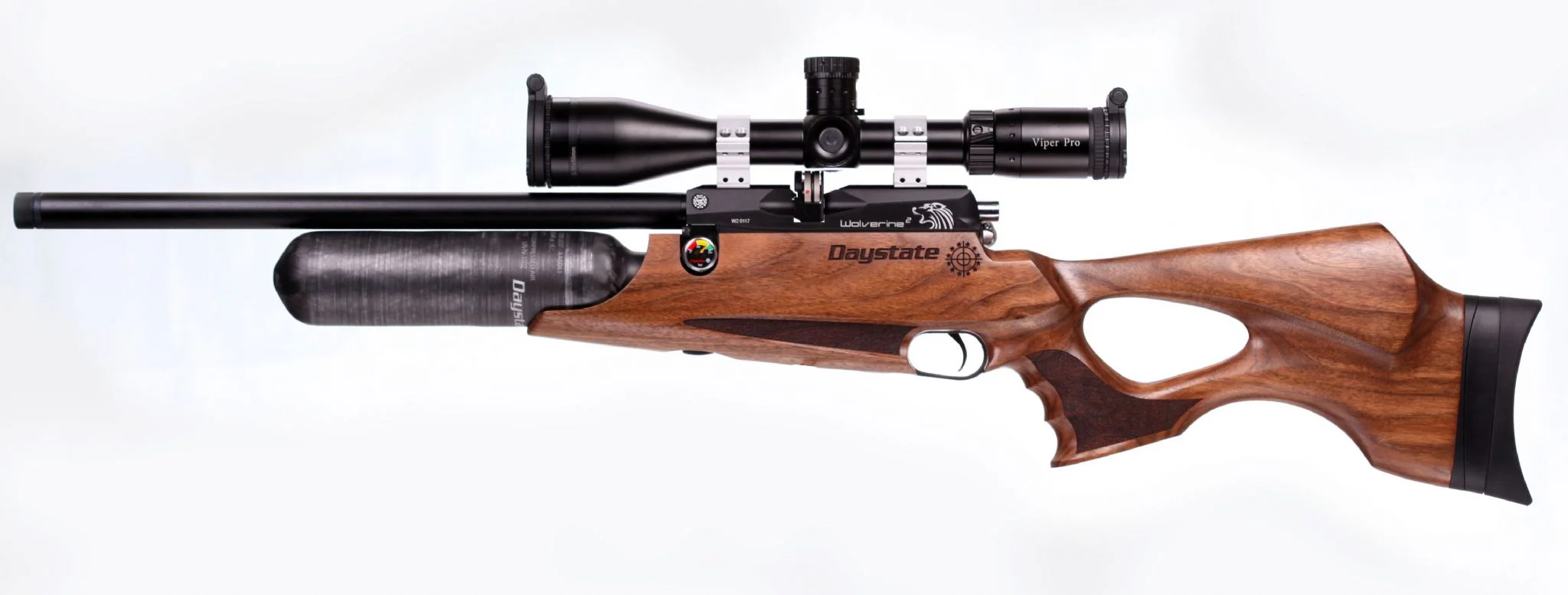
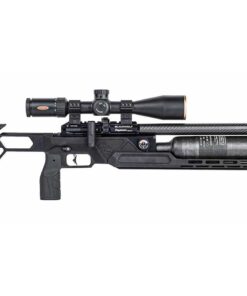
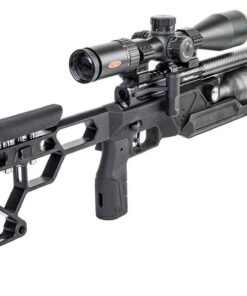
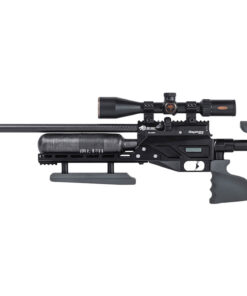
A fully mechanical pre-charged pneumatic action is employed. Furthermore, electronic firing systems are omitted so that a traditional cycle is retained. Moreover, a factory regulator is integrated so that each shot is metered from a consistent working pressure. Consequently, velocity variation across a usable fill is reduced. In addition, a side-lever cocking system is fitted so that the action can be cycled without a conventional bolt handle. Therefore, a regulated mechanical PCP of classic sporter layout is represented.
How does the regulator improve shooting?
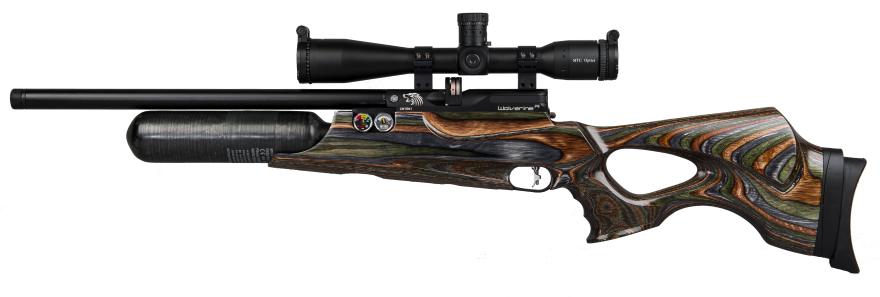
Measured air is delivered to the valve by the Huma-type regulator fitted inside the action. As a result, muzzle velocity is held within a narrow band from the first usable shot to the last. Subsequently, group size at typical airgun distances is tightened because pellets leave the barrel under similar conditions. Meanwhile, air is used more efficiently than on an unregulated buddy-bottle rifle of comparable volume. Hence, a greater number of consistent shots can be obtained from the same reservoir. Notably, a second gauge is provided so that regulator pressure can be observed independently of cylinder pressure.
How many shots can be expected from one fill?
Shot count is influenced by calibre, pellet weight, fill pressure and factory power setting. Furthermore, the 480 cc carbon-fibre bottle is filled to a working pressure of up to 250 BAR. Moreover, published figures for standard-limit use commonly indicate several hundred shots in .177 and .22 when energy is held near 12 ft/lb. Likewise, higher-energy settings reduce the number of shots while increasing downrange authority. Therefore, a full session can often be completed without a mid-day refill when legal-limit power is selected. Actual results should be confirmed with a chronograph after the preferred pellet is chosen.
Which calibres are offered?
Popular diameters are supplied so that trajectory and energy can be matched to the intended task. Additionally, .177 is favoured when a flatter path and high shot count are required. In contrast, .22 is widely chosen for general field work because a practical balance of energy and pellet availability is provided. Meanwhile, .25 is listed on many examples where greater momentum is desired. High-power chassis variants may also be offered in .30 where licensing permits. Inclusive choice is intended so that target shooters and field users can select the diameter that suits local law and quarry.
Is an FAC or high-power version available?
Yes. A longer-barrel high-power configuration exists within the same family. Consequently, energy figures well above typical unlicensed limits can be specified for markets in which such power is lawful. Furthermore, magazine capacity is reduced in the largest calibre and shot count falls as energy rises. Moreover, a firearms certificate or equivalent authorisation is required in many jurisdictions before a high-power example may be purchased or possessed. Legal limits must be verified locally; no rifle should be ordered that exceeds the licence held.
What fill pressure is used?
A maximum fill of 250 BAR (approximately 3,625 psi) is accepted by the carbon-fibre reservoir on this specification. Additionally, a working fill printed on the action or handbook should be observed so that the regulator remains in its designed window. Overfilling is avoided so that seals and the bottle are protected. A compatible probe and a clean, dry air source are required. Moisture from some hand pumps can be introduced if care is not taken; a filter and correct technique are therefore recommended.
How heavy and how long is the rifle?
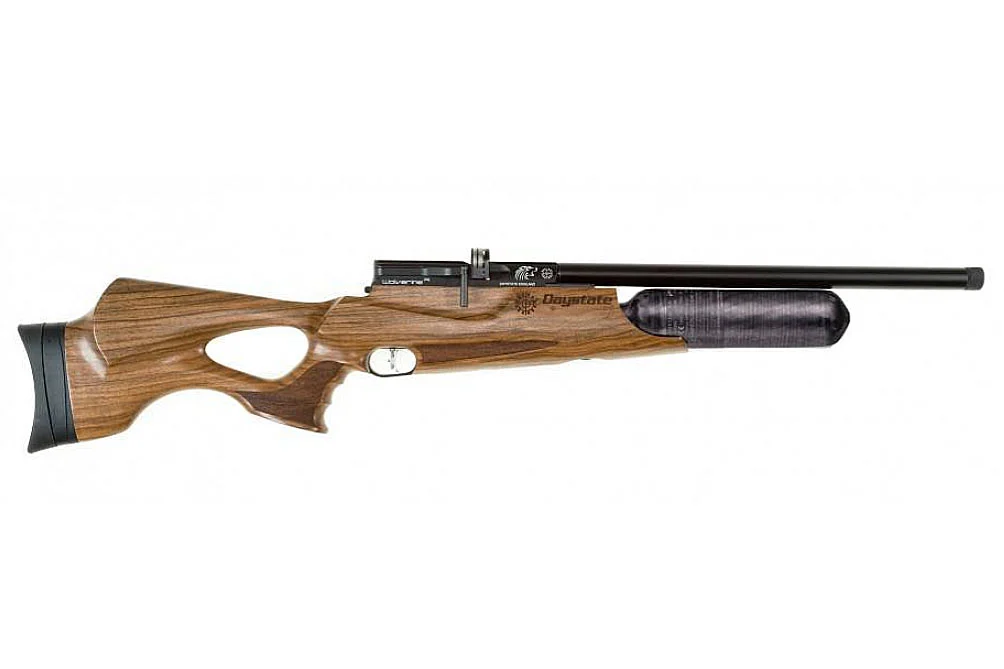
An unscoped weight of approximately 3.5 kg (7.5 lb) is typical for the carbon-bottle, 17-inch-barrel layout. Furthermore, overall length is approximately 96.5 cm (38 in). Moreover, high-power versions with a 23-inch barrel are longer and slightly heavier. Consequently, a full-size sporter rather than a bullpup is represented. Balance is aided by the under-barrel bottle so that a steady hold can be maintained in standing, kneeling and supported positions.
Can left-handed shooters use this rifle comfortably?
An ambidextrous thumbhole stock is fitted so that either shoulder can be used. In addition, the side lever is factory-reversible so that cocking from the left or right side can be specified. Likewise, the magazine and single-shot tray are designed for access from either side on typical examples. Therefore, inclusive handling is supported without a dedicated left-hand action. Cheek alignment is further refined by the adjustable butt pad.
Is a magazine or a single-shot tray supplied?
Both systems are provided. A self-indexing rotary magazine is included so that follow-up shots can be taken quickly. Capacities are typically 13 rounds in .177, 11 in .22, 10 in .25 and fewer in .30. Furthermore, a magnetic single-shot tray is supplied so that individual pellets can be loaded for bench work or when magazine feed is not preferred. Switching between the two methods is straightforward once the action is made safe.
What kind of trigger and safety are fitted?
A two-stage mechanical trigger is used. Weight and length of the first and second stages can be adjusted so that a predictable release is obtained. Furthermore, a manual cross-bar safety is fitted. Moreover, a lever-open deactivation system is incorporated so that the rifle cannot be fired while the action remains open. Consequently, a safety layout familiar to many firearm users is provided. The safety should be applied whenever the rifle is not aligned with a safe target.
Can a silencer be fitted?
A ½ UNF thread is normally present at the muzzle of the shrouded barrel. Therefore, a compatible moderator can be attached after the thread protector is removed. An Airstream-style or similar can is frequently chosen so that report is reduced for field use. Local rules on sound moderators must be observed. Group testing should be repeated after a silencer is added because point of impact may shift slightly.
Which scope and mounts are recommended?
A 9–11 mm dovetail rail is provided. Quality one-piece or two-piece mounts matched to the scope tube should be selected. Furthermore, airgun-rated optics with adjustable parallax are preferred because typical engagement distances are shorter than those used with firearms. Magnification in the 3–12× or 4–16× class is commonly chosen. Inclusive fitting is possible for shooters of different eye relief needs once the butt pad and scope position are set together.
How should the barrel and action be maintained?
The barrel should be cleaned at conservative intervals—often after several hundred shots—using methods suitable for precision rifled tubes. Additionally, the fill probe and O-rings should be inspected and lightly lubricated with airgun-safe grease as directed in the handbook. Moisture must be kept out of the reservoir. The regulator is a sealed unit and should not be dismantled by the owner. Professional service is advised if gauges, the lever or the trigger behave abnormally.
Which pellets work best?
Domed pellets of consistent weight from established makers are generally favoured for hunting and outdoor target work. Wadcutters may be chosen for short-range paper punching. Furthermore, each barrel prefers a particular head size and weight; therefore, a sample of two or three quality brands should be tested over a chronograph and at the intended zero distance. Alloy or extra-heavy slugs are not assumed to suit every power setting. The pellet that produces the smallest group at the required energy should be adopted.
What air source is needed for filling?
A dedicated PCP compressor, a scuba or carbon bottle with a suitable whip, or a high-quality hand pump can be used. Dry, filtered air is essential. Maximum working pressure of the rifle must not be exceeded. A bleed function on the filling hose is required so that the probe can be disconnected safely. Inclusive advice applies to all users: filling should be carried out in a well-ventilated area with eye protection and the rifle pointed in a safe direction.
How does this carbon-bottle version differ from tube or alloy-bottle variants?
A 480 cc carbon-fibre reservoir is used on the HiLite specification so that a large charge is stored at lower weight than many alloy bottles of similar volume. Tube (C-type) versions carry less air and are lighter still. Alloy buddy bottles in 400 cc or 500 cc form another option on related chassis. High-power models add barrel length and energy. The regulated side-lever action remains the common element across these layouts.
Is the rifle suitable for hunting and pest control?
Ethical use depends on legal energy, pellet choice, range and shot placement. At lawful power, small-pest work at modest distances can be undertaken when a suitable calibre and a well-zeroed optic are employed. Higher-energy FAC examples extend capability where licensing allows. Inclusive field practice requires a safe backstop, positive identification of the target and compliance with landowner and wildlife rules. The rifle itself does not confer permission to hunt.
How consistent is velocity from shot to shot?
Very small spreads are commonly reported when quality pellets are used and the fill is kept within the regulator’s working range. Independent tests have recorded variations of only a few feet per second over strings of tens of shots. Consistency is the principal reason the regulator was added to this mechanical platform. Chronograph verification after any pellet or power change is still recommended.
What warranty and support can be expected?
A lifetime warranty is widely advertised by the manufacturer when the rifle is used and maintained according to the handbook. Consumable seals, probes and magazines remain serviceable items. Authorised service centres should be used for regulator or valve work. Proof of purchase and serial number are typically required. Inclusive after-sales support is intended for owners who follow filling and safety instructions.
Are there any special safety points for new owners?
The manual safety should be applied whenever the muzzle is not on a safe target. The lever-open lockout must not be relied upon as the only control. Unattended rifles should be stored unloaded, with air managed according to local law and the maker’s advice. Children and inexperienced users must be supervised. Inclusive participation in the sport is welcomed only when these rules are observed.
What should be checked before the first range session?
Fill pressure, regulator gauge reading, magazine fit and scope mounting should be confirmed. A few shots over a chronograph establish whether factory energy matches the intended legal limit. Zero should be set at a realistic distance with the chosen pellet. Hearing and eye protection are advised. When these steps are completed, the regulated mechanical action can be used with greater confidence on the range or in the field.
Practical Use Scenarios
A regulated mechanical PCP of this type is employed across club ranges, permission ground and informal practice. Furthermore, consistent velocity is relied upon so that holdover and wind calls remain repeatable. Moreover, a large carbon-fibre reservoir is used so that a full outing can often be completed from a single fill. Consequently, time spent on the compressor or dive bottle is reduced. Inclusive use is intended for right- and left-handed shooters once the side lever and stock are set correctly. Local law, safe backstops and ethical shot placement must always be observed.
Zeroing and First Range Session
A stable bench or bags are used so that the optic can be aligned with the barrel. Additionally, a quality domed pellet of known weight is selected after a short comparison string. The first group is fired at a short distance so that the scope can be brought onto paper without wasted air. Subsequently, the zero distance appropriate to the calibre and legal energy is confirmed—often 25 to 35 yards for sub-12 ft/lb work, farther where FAC energy and a suitable backstop are available.
A chronograph is placed so that muzzle velocity can be recorded across a magazine. As a result, extreme spread is checked against the regulator’s expected consistency. Meanwhile, the cylinder gauge and the regulator gauge are both observed so that the fill remains inside the working window. If velocity climbs or falls outside a tight band, the fill pressure or pellet is revisited before field use is attempted. Hearing and eye protection are worn throughout.
The two-stage trigger is adjusted only after a safe, empty demonstration of the stages is completed. Light first-stage travel is preferred by many target users; a slightly heavier break may be chosen for gloved winter pest control. Inclusive setup is achieved when length of pull, cheek weld and eye relief are refined together using the adjustable butt pad.
Club Target and Informal Practice
High shot counts at legal-limit energy make extended paper or spinner sessions practical. Furthermore, a rotary magazine is loaded so that rhythm can be maintained between sighters and record shots. Moreover, the magnetic single-shot tray is substituted when group testing or HFT-style single loading is required. Consequently, both rapid strings and deliberate singles are supported on the same action.
Wind flags are watched because even a consistent rifle cannot cancel drift. Hold-off is applied rather than constant scope adjustment once a reliable zero is known. Likewise, pellet choice is locked after the smallest group is identified; mixing brands mid-session is avoided so that the regulator’s consistency is not masked by ammunition change.
Standing and kneeling practice is included so that field positions are rehearsed. The 38-inch layout and under-barrel bottle produce a familiar sporter balance. Fatigue is reduced compared with heavier unregulated bottles of similar capacity, yet a sling or rest is still used for longer strings. Inclusive participation is encouraged when lane rules, muzzle discipline and the manual safety are respected by every shooter on the line.
Permission Work and Pest Control
Ethical pest control is possible only where energy, calibre, range and shot placement meet a humane standard and the law. A .22 pellet at lawful power is frequently chosen for typical small-pest distances. A .177 pellet may be preferred when a flatter trajectory is needed and the target is close. Heavier .25 or FAC loads are reserved for licensed use and appropriate quarry.
A silent approach is aided when a ½ UNF moderator is fitted and tested for point-of-impact shift. Furthermore, the side lever is cycled only when a shot is imminent so that movement is minimised. Moreover, the cross-bar safety remains applied until the muzzle is on a verified target with a safe backstop. Positive identification is completed before the first stage is taken up.
A single fill often covers a dawn or dusk circuit because several hundred consistent shots are available at limit power. Gauges are glanced at between stands so that a return to the vehicle for air is planned rather than forced. Magazines are pre-loaded at home; a spare magazine and the single-shot tray are carried so that a feed issue does not end the outing.
Weather is considered. Light rain does not stop a sealed PCP, yet optics and the fill port are kept clear. Strong wind reduces ethical range; shots are declined when drift cannot be called with confidence. Inclusive fieldcraft applies to all body types: a stable kneeling or sitting position is chosen over an unsteady standing shot whenever time allows.
Supported Long-Range Practice on Private Land
Where FAC energy and a long, safe stop-butt exist, the high-power chassis variant is used so that heavier pellets can be evaluated. Trajectory cards are prepared after chronograph work. Furthermore, the longer barrel of that specification is given time to settle after a fill. Groups are fired only when conditions are readable. Subsequently, the same pellet and the same hold are repeated so that the regulator’s metering can be judged rather than the shooter’s improvisation.
A bipod or bags are employed for diagnosis; field positions are then repeated so that real-world groups are known. Heat shimmer and changing wind are recorded. If spread grows as the bottle empties toward the lower gauge mark, the usable shot window is noted and future fills are planned inside that window. No shot is taken beyond the distance at which clean, humane placement can be guaranteed.


Reviews
There are no reviews yet.