
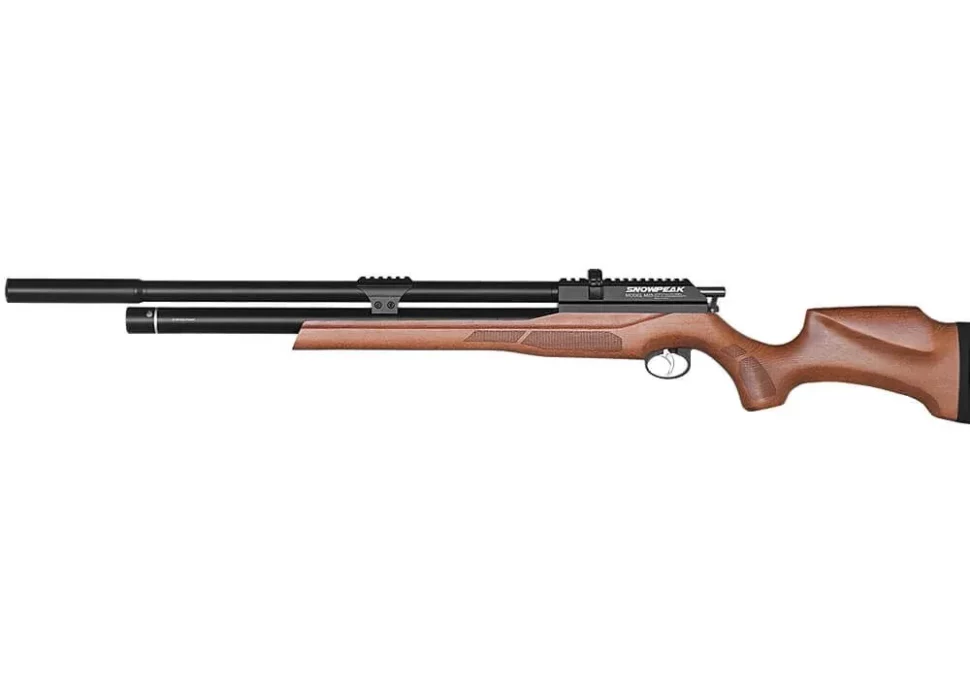
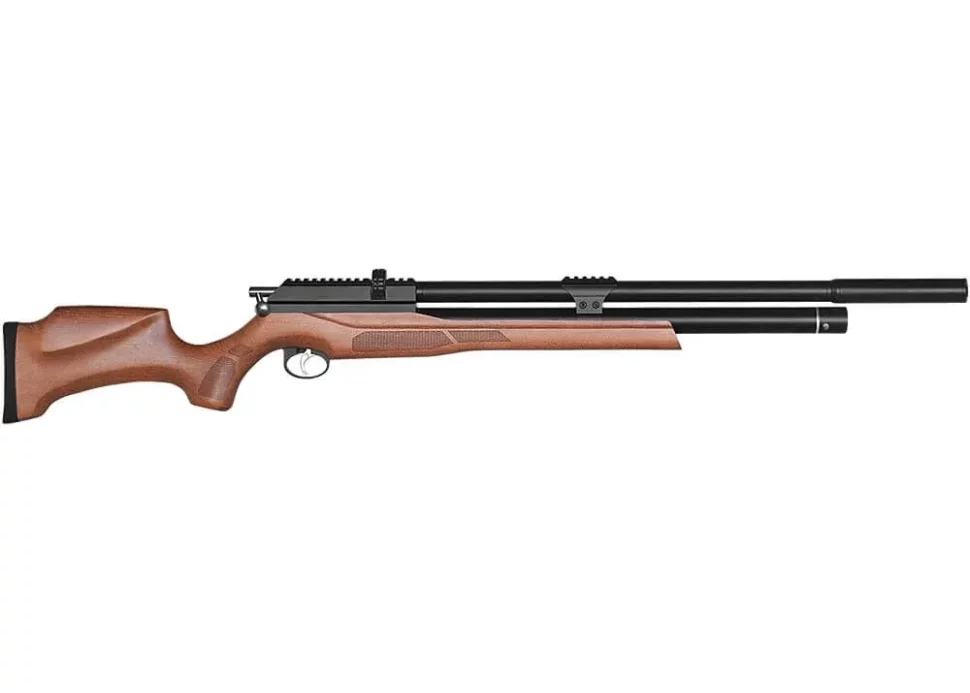
Shooters seeking a reliable, accurate, and elegant pre-charged pneumatic air rifle often look for a model that balances traditional aesthetics with consistent power delivery. The Snowpeak M25W delivers exactly that combination. This full-size PCP carbine pairs a handsome European beech wood stock with a regulated air system, integrated sound moderation, and versatile multi-shot capability. Whether you focus on target practice, pest control, or recreational plinking, the Snowpeak M25W offers dependable performance that supports shooters of every experience level.
Many air rifles force a choice between classic looks and modern features. The Snowpeak M25W removes that compromise. Its traditional beech wood sporter stock features a comfortable pistol grip with checkering on both the grip and forend. Consequently, the rifle provides a secure hold in varied conditions. A raised cheek piece aligns the eye naturally with a scope mounted on the Weaver/Picatinny rail, while an integrated rubber butt pad absorbs residual impulse for greater comfort during longer sessions.
Furthermore, the ambidextrous design welcomes both left- and right-handed users without awkward adaptations. The overall length measures approximately 1230 mm, and the weight settles near 3.4 kg, creating a balanced platform that feels stable yet manageable in the field or on the range.
Power consistency remains one of the most important factors for accuracy in any PCP air rifle. The Snowpeak M25W incorporates a built-in regulator that maintains steady pressure shot after shot, provided the reservoir pressure stays above the regulated threshold. As a result, velocity remains predictable across a full string of shots rather than declining as the air cylinder empties.
The 250 cc (approximately 245–250 cc depending on exact configuration) air cylinder fills to a maximum of 250 bar / 3626 psi. This capacity supports a useful number of consistent shots before a refill becomes necessary. In addition, the included fill probe allows straightforward charging from a suitable high-pressure source equipped with a compatible Foster-style connection.
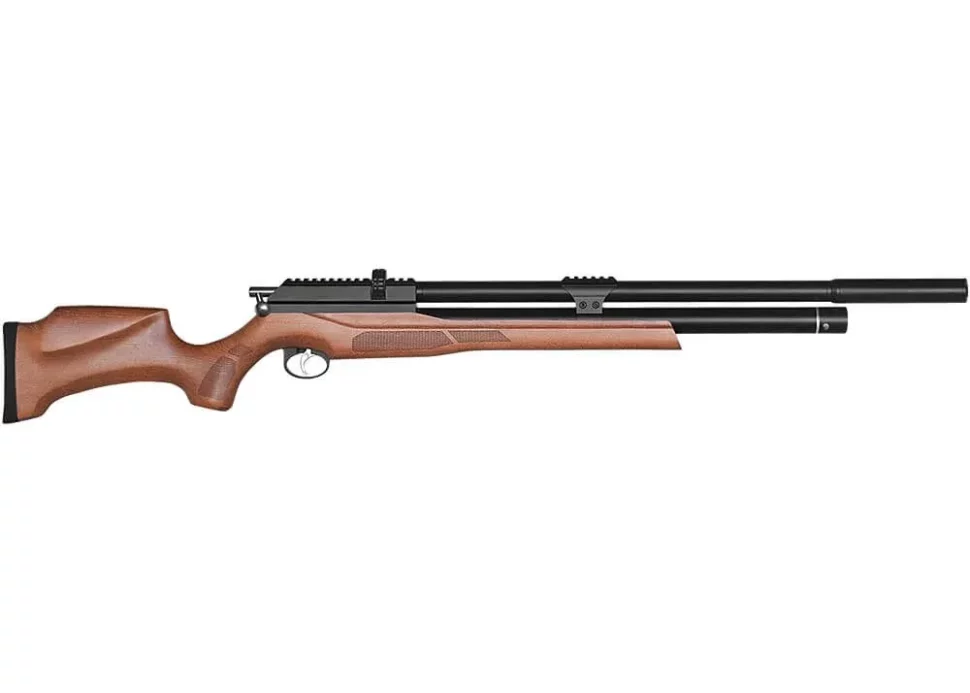
Noise reduction matters for backyard practice, discreet pest control, and range etiquette. The Snowpeak M25W features a shrouded barrel fitted with an integrated or removable sound moderator. This design meaningfully lowers the report compared with unmoderated barrels, creating a more pleasant shooting experience for the user and nearby observers.
The 550 mm rifled steel barrel contributes to solid accuracy potential. Paired with the regulator and a smooth bolt-action cocking system, the rifle supports both multi-shot magazine use and single-shot tray operation. Therefore, shooters can choose rapid follow-up capability or deliberate single-pellet loading according to the situation.
These elements combine to create a versatile platform. Moreover, the classic wood finish gives the Snowpeak M25W a refined appearance that many synthetic-stocked rifles lack.
Different shooting goals call for different calibers. The Snowpeak M25W accommodates several popular options, allowing users to match pellet weight, trajectory, and terminal performance to their needs. Higher-energy configurations in larger calibers suit bigger targets or longer-range work, while mid-range calibers excel at precision target shooting and small-game applications where legal and ethical.
Because the rifle supports both magazine-fed repeating fire and single-shot tray use, it adapts easily. In practice, many owners keep a loaded magazine for general sessions and switch to the tray when testing new pellets or focusing on maximum precision. The smooth bolt action further supports this flexibility by enabling quick, reliable cycling without excessive effort.
Comfort directly influences accuracy and enjoyment. The Snowpeak M25W addresses this through thoughtful stock design. The checkered pistol grip and forend improve purchase, especially when gloves are worn or conditions turn damp. The raised cheek piece reduces the need for excessive head movement when using a scope. Meanwhile, the rubber butt pad softens the shoulder interface.
Consequently, shooters of varying builds and experience levels can settle into a stable position more readily. The balanced weight distribution also helps reduce fatigue during longer range sessions or when moving between shooting positions.
Recreational shooters appreciate the combination of classic aesthetics and modern consistency. Target enthusiasts value the regulated power curve and adjustable trigger. Pest controllers and small-game hunters (where permitted) benefit from the moderated report and multi-shot capability. New PCP owners often find the included accessories and straightforward operation lower the learning curve, while experienced users enjoy the solid foundation for optics and accessories.
In short, the Snowpeak M25W serves a broad audience without forcing major compromises.
The Snowpeak M25W brings together traditional wood-stock appeal, regulated PCP performance, quiet operation, and practical multi-shot versatility in one well-balanced package. Its combination of consistent power, comfortable ergonomics, and useful accessories makes it a strong contender for anyone seeking a capable full-size air rifle that looks as good as it shoots.
Explore available calibers and configurations to match your preferred style of shooting. With its thoughtful design and reliable features, the Snowpeak M25W stands ready to deliver accurate, enjoyable sessions for shooters of all backgrounds. Add one to your collection and discover how classic form and modern function work together.
Modern optical technology gives hunters, sport shooters, wildlife observers, and outdoor enthusiasts more ways to identify distant targets, measure range, and achieve a clearer field of view. Premium Leica rangefinder binoculars remain highly regarded for combining observation and ranging technology in one compact optical platform. Popular searches include Leica Geovid 10×42 rangefinder binoculars, Leica Geovid binoculars, Leica binoculars with rangefinder, Leica Geovid Pro 10×42, and Geovid Pro 10×42. Whether someone is researching a Leica Geovid rangefinder, Leica Geovid Pro rangefinder binoculars, Leica Geovid rangefinder binoculars, or the classic Leica Geovid 10×42, the Geovid family is commonly associated with high-quality glass, strong optical clarity, and practical long-distance observation.
Beyond rangefinding models, the wider Leica binoculars collection appeals to users searching for Leica small binoculars, binoculars Leica, Leica Geovid binos, Leica bino, Leica binoculars for sale, Leica bino rangefinder, Leica camera binoculars, Leica binos, or simply a Leica binocular for travel, field observation, wildlife viewing, and outdoor use. Different magnification formats, including 10×40, can suit users who want a balance between detail, portability, and field of view.
Alternative electronic binocular technologies are also becoming increasingly popular. Searches for SIG Sauer binoculars, SIG self stabilizing binoculars, SIG Sauer binos, SIG binoculars, SIG image stabilizing binoculars, SIG binocular, and SIG auto stabilizing binoculars reflect growing interest in electronically assisted viewing. Likewise, SIG Sauer self stabilized binoculars and SIG Sauer image stabilized binoculars can appeal to users who want reduced visual movement during handheld observation. Some buyers may also encounter broader search variations such as Sigma binoculars or specification terms like 11.5ee while comparing different optical products.
Precision aiming optics occupy another major part of the premium optics market. A Zeiss red dot offers a different sighting concept from traditional magnified optics, while the Nightforce ATACR line is frequently researched by users interested in premium long-range scopes. Common variants include Nightforce ATACR 5-25×56 F2, Nightforce ATACR 4-20×50, Nightforce ATACR 5-25×56 F1, and Nightforce ATACR 4-16×50. Related searches such as Night Force ATACR, ATACR scope, Nightforce attacker, ATACR 4-20, and Nightforce ATACR 4 20×50 F1 often appear when buyers are comparing magnification ranges, focal-plane configurations, turret systems, and optical performance.
At the higher end of precision optics, Tangent Theta products are frequently associated with specialist applications requiring refined mechanical adjustment and premium optical performance. Users may search for Tangent Theta scopes, Tangent scope, Tangent scopes, Theta optics, Tangent Theta scope, and Tangent optics while researching high-performance long-range systems.
The market also includes companies such as Fierce Firearms, Fierce Arms, and Fierce Optics, which may appear in searches involving hunting equipment and optical accessories. Within the Athlon category, meanwhile, one of the more detailed product searches is Midas TAC Gen2 HD 6-24×50 APLR15 FFP MOA reticle riflescope. The broader Athlon Midas TAC family, including Athlon Midas TAC 6-24×50, is often considered by users who want substantial magnification and adjustable target-focused features.
For shooters comparing larger objective and magnification configurations, terms such as 34 56, 34×56, Athlon Argos BTR Gen2 8-34×56, Athlon BTR Gen 2, Athlon Argos BTR Gen2, Athlon Argos BTR, and Athlon Argos BTR Gen 2 commonly appear during product research. Search variations such as Athalon scopes and Athens scope may also lead shoppers toward Athlon products when researching a new gun scope, Icarus scope, longest range scope, or general hunting optic.
Anyone learning how to buy a rifle scope should compare magnification range, objective diameter, reticle design, adjustment system, eye relief, optical quality, focal-plane configuration, overall weight, and intended sporting application. Terms such as AO scope can refer to adjustable-objective configurations, while models in the Athlon Ares BTR family provide additional options for users exploring precision-oriented optics.
Mid-range magnification searches frequently include 2.5×15, Avalon Aries, 2.5/15, Athlon BTR Gen 2, Athlon scopes review, Athlon reticles, 2.5-15 scope, and repeated comparisons involving Athlon Argos BTR Gen2 8-34×56 or 34×56 configurations. These searches demonstrate how buyers often compare reticles, magnification ratios, objective sizes, and scope families rather than selecting an optic solely by maximum magnification.
Low-power variable optics are another major category. Searches such as 1 10 scope, Ares ETR 1 10, 1 10 LPVO, 1-10 LPVO, 1-10 FFP LPVO, 1×10 scope, Athlon ETR, LPVO 1-8, LPVO 1-10, and 1-10 rifle scope reflect demand for versatile magnification systems. An LPVO allows users to move between low magnification for a broad field of view and higher magnification for improved observation at extended distances, making the format useful across several sporting disciplines.
For greater magnification, the Ares ETR Gen2 UHD 4.5-30×56 APRS12 FFP IR MIL reticle represents another precision-focused configuration within the Athlon range. Related product searches include Athlon 4.5-30×56, 4.5 30, Athlon ETR, and 4.5/30. The large 56 mm objective and broad magnification range make this type of optic particularly relevant to users comparing long-distance target and field optics.
Other searches such as 14×44, 2s14, Athlon BTR 2-12, 1/2×42, Athlon BTR Gen 2, 12×4.2, 2-12x, and Athlon 2 demonstrate continued demand for more compact variable-magnification formats. A 2-12x configuration, for example, can provide a useful compromise between field of view and magnified observation without requiring the size or weight of a very high-magnification optic.
Ultimately, premium optics cover far more than a single product category. Leica rangefinder binoculars and Leica Geovid binoculars combine observation with distance measurement, while stabilized SIG Sauer binoculars emphasize steady handheld viewing. Meanwhile, Nightforce ATACR, Tangent Theta scopes, and Athlon families such as the Midas TAC, Argos BTR, Ares BTR, and Ares ETR provide a wide range of magnification, reticle, and focal-plane options. By comparing optical clarity, magnification range, objective diameter, reticle format, adjustment system, physical dimensions, and intended sporting use, buyers can narrow a broad optics market into products that better match their individual requirements.
Frequently Asked Questions about the Snowpeak M25W
This regulated pre-charged pneumatic air rifle combines classic wooden aesthetics with modern performance features that appeal across skill levels. Newcomers appreciate the straightforward bolt-action operation, included single-shot tray and multi-shot magazine, and the consistent power delivery that reduces the learning curve associated with velocity drop-off. Experienced users value the adjustable two-stage trigger, solid Weaver/Picatinny rail for optics, and the ability to select from several calibres that match specific applications. The ambidextrous beech stock with raised cheek piece and rubber butt pad further supports comfortable shooting for left- and right-handed individuals of varying builds. As a result, the rifle serves recreational target practice, precision work and field use equally well when local regulations permit.
The rifle commonly appears in 5.5 mm, 6.35 mm, 7.62 mm and 9 mm configurations. The 5.5 mm option offers a versatile balance of trajectory, accuracy potential and magazine capacity, typically around ten rounds, making it popular for general target shooting and smaller applications. Stepping up to 6.35 mm increases pellet mass and energy transfer while retaining good capacity, often nine rounds, which helps in conditions with moderate wind or when greater impact is desired. The 7.62 mm and 9 mm versions deliver higher energy levels suited to specialised needs, although magazine capacity decreases accordingly to eight and six rounds respectively. Each calibre pairs with the same 550 mm rifled barrel and regulated system, so the core shooting experience remains familiar while pellet behaviour and terminal performance change. Shooters therefore select according to intended distance, target type and personal preference rather than compromising on the rifle’s fundamental design.
A built-in regulator maintains more consistent pressure behind each pellet as long as the air reservoir stays above the set threshold. Without regulation, velocity typically declines as cylinder pressure falls, forcing frequent hold-over adjustments and producing larger groups. With regulation, shot-to-shot variation decreases markedly, which simplifies aiming and improves group size across a useful string of shots. The 250 cc class air cylinder fills to a maximum of 250 bar, providing a practical number of consistent shots before a refill is required. Consequently, users spend less time compensating for power drop and more time focusing on technique and target engagement. This consistency benefits both short practice sessions and longer outings where multiple strings are fired.
Energy output varies by calibre and the specific factory tuning of each version. Typical figures range from the mid-40 joule area in smaller calibres up to well over 100 joules in the largest options, although exact numbers depend on pellet weight and regional configurations. Some markets offer restricted-power models kept below common legal thresholds such as 19.9 joules or 24 joules so that no special licence is required. In jurisdictions such as the United Kingdom, any air rifle exceeding 12 foot-pounds requires a Firearms Certificate. Prospective owners must therefore verify the precise energy rating of the individual rifle they intend to purchase and confirm the licensing rules that apply in their location. Responsible purchase always begins with this legal check. Once the correct power band is selected, the regulated system helps deliver that energy in a stable manner rather than a declining curve.
Standard equipment usually includes one rotary magazine matched to the calibre, a single-shot loading tray, a fill probe with Foster-style connection, spare O-rings, a muzzle thread protector and a basic tool set. These items allow immediate filling, loading and shooting. Many owners later add a quality optic on the Weaver/Picatinny rail, taking advantage of the raised cheek piece for natural eye alignment. An under-forend accessory rail, present on numerous versions, accepts bipods that improve stability during zeroing or supported shooting. Spare magazines reduce reload time during extended sessions, while a reliable high-pressure air source—hand pump, scuba tank or compressor fitted with the matching coupling—ensures the cylinder can be topped up conveniently. Soft or hard cases protect the wooden stock during transport, and a basic cleaning kit plus extra seals support long-term reliability. Selecting accessories that complement the existing ergonomics and regulated performance yields the greatest improvement in comfort and results.
The shrouded barrel incorporates an integrated or removable moderator that meaningfully reduces the report compared with an unmoderated muzzle. Quieter operation benefits backyard practice, range sessions where noise etiquette matters, and field situations where discretion is preferred. The moderation does not eliminate sound entirely, yet it lowers the signature enough to make the rifle more neighbour-friendly and less startling to wildlife when used for permitted pest control. Combined with the consistent regulated power, the reduced noise contributes to a more pleasant overall shooting experience without sacrificing the accuracy potential of the 550 mm barrel.
Yes. The beech wood stock is designed as ambidextrous, with a pistol grip and forend checkering that work equally well for either hand. The raised cheek piece provides proper eye alignment whether the user mounts the rifle on the left or right shoulder. The rubber butt pad softens the interface and helps accommodate different shoulder positions and clothing layers. Overall length near 1230 mm and weight around 3.4 kg create a full-size yet balanced platform that remains manageable for a wide range of adult shooters. Individuals with shorter or longer reaches can often find a comfortable hold, although those at the extremes of stature may benefit from experimenting with different scopes and mounting heights to optimise eye relief and cheek weld.
Routine care focuses on keeping seals healthy, the barrel clean and the exterior protected. After shooting sessions, a light wipe-down of the metal surfaces prevents moisture accumulation. Periodic inspection and replacement of O-rings, especially those associated with the fill port and regulator area, maintain air-tight integrity. Barrel cleaning with appropriate rods, patches and solvents suited to the calibre removes lead and debris that can degrade accuracy. The wooden stock benefits from occasional application of a suitable oil or conditioner to preserve its appearance and resist drying. Always follow safe depressurisation procedures before any internal work, and store the rifle with a modest residual pressure rather than completely empty when possible. These simple habits extend service life and preserve the consistent performance that the regulated system is designed to deliver.
Absolutely. The rotary magazine enables rapid follow-up shots once the bolt is cycled, while the supplied single-shot tray allows precise loading of individual pellets, including longer or specialised designs that may not fit the magazine. Switching between the two modes requires no tools and takes only moments. Many shooters keep a loaded magazine for general practice or field use and switch to the tray when testing new pellets, zeroing a scope or focusing on maximum precision. The smooth bolt-action cocking system supports both styles equally well, giving users flexibility without compromising reliability.
Begin by confirming that the chosen power level complies with local law and that any required certificate is in hand. Fill the cylinder to the recommended pressure using the supplied probe and a suitable air source. Mount a quality optic if desired, ensuring the eye relief and cheek weld feel natural. Start at moderate distances with the single-shot tray to establish a reliable zero, then progress to the magazine once groups are consistent. Record velocities if a chronograph is available so that the regulated performance can be observed across a string. Focus on fundamental positions, trigger control and follow-through rather than immediate high-volume shooting. These measured steps build familiarity with the rifle’s handling, power curve and accuracy potential while reinforcing safe practices.
Airgun laws differ substantially between countries and even regions. Confirm the exact energy rating of the specific rifle, the maximum permitted power without a licence, and any requirements for storage, transport or use on private or public land. Always treat the rifle as a powerful tool: keep the muzzle pointed in a safe direction, keep the finger off the trigger until ready to fire, and be certain of the target and what lies beyond it. Store the rifle securely and separately from pellets when not in use. Never modify the regulator or other components in ways that could increase power beyond legal limits or compromise safety. Adhering to these principles protects the owner, bystanders and the continued legal enjoyment of the sport.
The combination of a classic beech stock, regulated consistency, moderated report, versatile loading options and solid accessory mounting creates a platform that remains satisfying after the initial novelty fades. Shooters can refine their setup with optics, bipods and spare magazines as skills and interests develop. The ambidextrous ergonomics and adjustable trigger accommodate different preferences, while the robust construction supports regular use when basic maintenance is observed. Whether the goal is relaxed plinking, structured target practice or responsible field applications, the rifle’s balanced features encourage continued engagement rather than rapid replacement.
These answers address the most common practical questions that arise when considering or owning the rifle. Careful attention to calibre selection, legal power limits, included accessories and routine care allows every shooter to extract the full potential of the design while maintaining safety and compliance.
Practical Use Scenarios: From First Shots to Confident Field Sessions
Stepping onto the range or into the field with a full-size regulated PCP air rifle changes the way many people approach shooting. The combination of consistent power, quiet operation and a comfortable wooden stock creates opportunities that feel more deliberate and enjoyable than high-volume plinking with springers. Below are realistic scenarios that illustrate how owners typically put the rifle to work, from initial familiarisation through regular practice and responsible field applications.
Most new owners begin at a formal range or a safe private property with a solid backstop. After confirming that the chosen power level complies with local rules, the cylinder is filled to the recommended pressure using the supplied probe. A modest optic is mounted on the rail and roughly aligned. Because the stock features a raised cheek piece, eye relief settles naturally for the majority of adult shooters, whether they shoot from the left or right shoulder.
The single-shot tray proves useful during the first hour. Loading one pellet at a time encourages focus on trigger control and follow-through while the shooter learns the rifle’s point of impact. Groups at 25 metres quickly reveal the benefit of regulation: velocity remains steady, so corrections stay consistent rather than changing with every few shots. Once a reliable zero is established, the rotary magazine is introduced. Cycling the bolt becomes a smooth, repeatable motion that supports controlled strings of five or ten shots without rushing.
Many shooters record a short chronograph string at this stage. Seeing the tight velocity spread builds confidence and provides a baseline for future checks. The moderated report keeps the session pleasant for others on the line and reduces the need for heavy hearing protection beyond basic plugs or muffs. By the end of the first outing most people leave with a clear sense of the rifle’s balance, trigger feel and practical accuracy potential.
Regular range visits turn initial impressions into reliable technique. A typical practice session might start with supported groups from a bench or bipod at 30 and 50 metres. The under-forend rail, when present, accepts a bipod quickly, turning the rifle into a stable platform for diagnosing hold and trigger issues. Because the regulator keeps power consistent, any vertical stringing is more likely the result of technique than declining air pressure.
Transitioning to unsupported positions follows naturally. Standing, kneeling and sitting shots at 25–40 metres highlight the value of the checkered pistol grip and forend. The rubber butt pad softens the shoulder interface during longer strings, while the overall weight around 3.4 kg provides enough inertia to dampen minor movements without becoming tiring. Shooters of different builds often experiment with scope height and ring position until the cheek weld feels automatic.
Magazine-fed strings of eight to ten shots encourage rhythm. The bolt cycles cleanly, and the self-indexing magazine presents the next pellet without fumbling. When a particular pellet lot produces especially tight groups, the single-shot tray allows further testing of heavier or longer designs that may not fit the magazine. Over successive sessions, most owners develop a preferred pellet and a set of hold-over marks that remain trustworthy because the power curve stays predictable.
Where local law and property boundaries permit, the moderated barrel opens the door to productive backyard sessions. The reduced report makes short practice periods less disruptive to neighbours and household members. A simple target board or spinner set at 20–30 metres becomes a convenient way to maintain trigger discipline between formal range trips.
These informal sessions often focus on positional work. Shooting from a garden chair, over a fence rail or from a kneeling position mimics field scenarios more closely than a bench. The ambidextrous stock accommodates left- and right-handed family members who share the rifle, and the manual safety provides a clear visual and tactile reminder before any movement around the property. Because the cylinder holds a useful number of regulated shots, a single fill supports an entire evening of deliberate practice without interruption.
In regions where air rifles are legal for pest control or small-game hunting, the combination of consistent energy, moderated sound and multi-shot capability proves practical. Landowners dealing with rabbits, rats or similar species often prefer a quiet, accurate tool that can be carried comfortably for extended periods. The wooden stock’s classic profile draws less attention than more tactical designs, while the raised cheek piece keeps the eye aligned with a low-powered scope during low-light periods at dawn or dusk.
A typical outing begins with a full cylinder and a loaded magazine. The shooter moves quietly, using available cover, and takes shots only when a safe backstop is confirmed. The regulator ensures that the first shot and the tenth carry similar energy, reducing the risk of marginal impacts as the session progresses. When a follow-up is required, the bolt can be cycled without breaking position significantly. After the outing the rifle is cleared, the residual pressure noted, and a light wipe-down performed before storage.
Ethical use always prioritises clean, decisive shots within the effective range of the chosen calibre and the shooter’s proven ability. Many experienced users limit themselves to distances where they can consistently place pellets in a vital zone under realistic field conditions rather than stretching to the theoretical maximum.
Extended time outdoors introduces different demands. A bipod or improvised rest becomes valuable when observing from a fixed position for longer periods. The accessory rail under the forend accepts such supports quickly. Combined with a comfortable cheek weld and the rubber butt pad, the rifle can remain shouldered or ready for extended watches without excessive fatigue.
Weather resistance of the oiled beech stock is generally good for typical conditions, although prolonged heavy rain prompts most owners to use a simple cover or return the rifle to a case when not actively in use. The fill probe stays in the range bag or vehicle so that a top-up can be performed if a portable tank is available. Because the system is regulated, even a partial refill restores consistent performance rather than producing a short, high-velocity spike followed by rapid decline.
Families or clubs that share equipment benefit from the ambidextrous design and adjustable trigger. A more experienced shooter can demonstrate proper mounting, breathing and trigger press, then hand the rifle to a newer participant without needing to reverse controls. The single-shot tray slows the pace for instructional purposes, while the magazine allows the learner to experience a realistic string once fundamentals are sound.
Progression often follows a clear path: supported zeroing, positional practice at known distances, introduction of mild time pressure or movement, and finally realistic field scenarios under supervision. Throughout this development the consistent power delivery removes one major variable, allowing attention to remain on the shooter rather than the equipment.
Practical ownership includes simple routines that keep the rifle ready. After each session the exterior is wiped, the bore is checked for obvious fouling, and the air pressure is noted. O-rings at the fill port receive occasional inspection. A light application of stock oil every few months preserves the wood’s appearance and moisture resistance. When groups begin to open, a thorough barrel cleaning and a fresh chronograph string usually identify whether the issue is lead build-up, a seal, or simply a change in pellet lot.
These habits require only a few minutes yet preserve the regulated consistency and quiet operation that make the rifle enjoyable in the first place. Owners who treat the equipment as a long-term tool rather than a disposable item typically report years of reliable service.
Over time the rifle becomes one element in a personal system. A dedicated soft case or hard case protects it during transport. A small selection of proven pellets travels with it. A bipod, spare magazine and basic cleaning kit complete the kit for most outings. Some owners keep a second optic with a different magnification range for specific tasks, swapping them as needed on the Picatinny rail.
The result is a flexible platform that supports short evening practice, structured range days, quiet garden sessions and responsible field use without demanding constant adjustment or specialised knowledge. Whether the goal is personal improvement, shared family activity or practical land management, the combination of consistent performance, comfortable handling and thoughtful features allows the rifle to fit naturally into varied routines.
By approaching each scenario with attention to safety, local regulations and personal skill limits, owners extract steady enjoyment and measurable progress. The rifle rewards deliberate use more than hurried volume, turning ordinary practice into satisfying, repeatable sessions that build both competence and confidence over months and years.
| Caliber | .22, .25, .30, .35 |
|---|
Snowpeak
Snowpeak
Snowpeak
Reviews
There are no reviews yet.