
$1,070.00
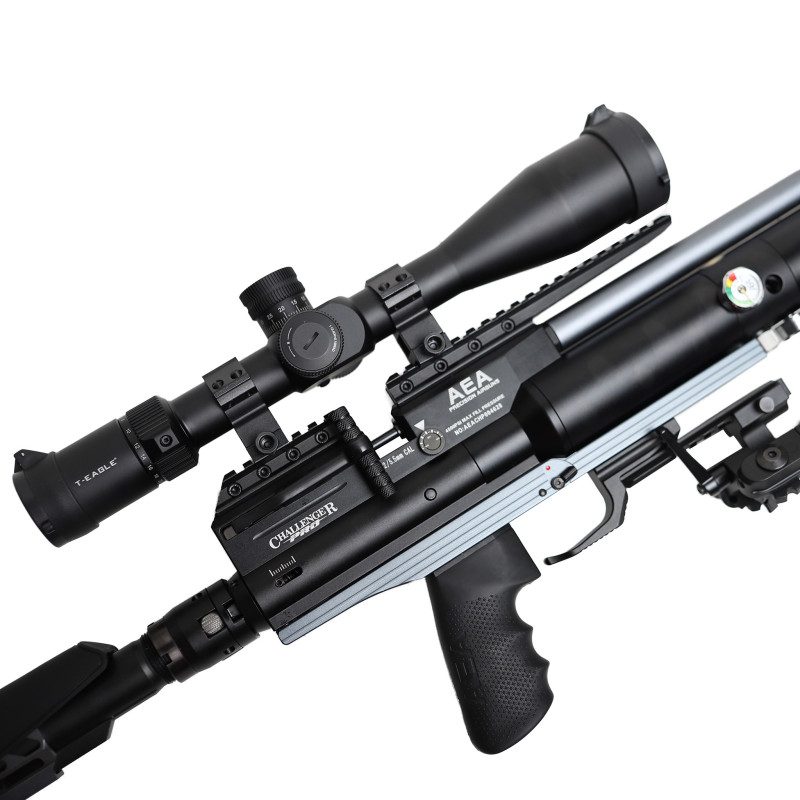
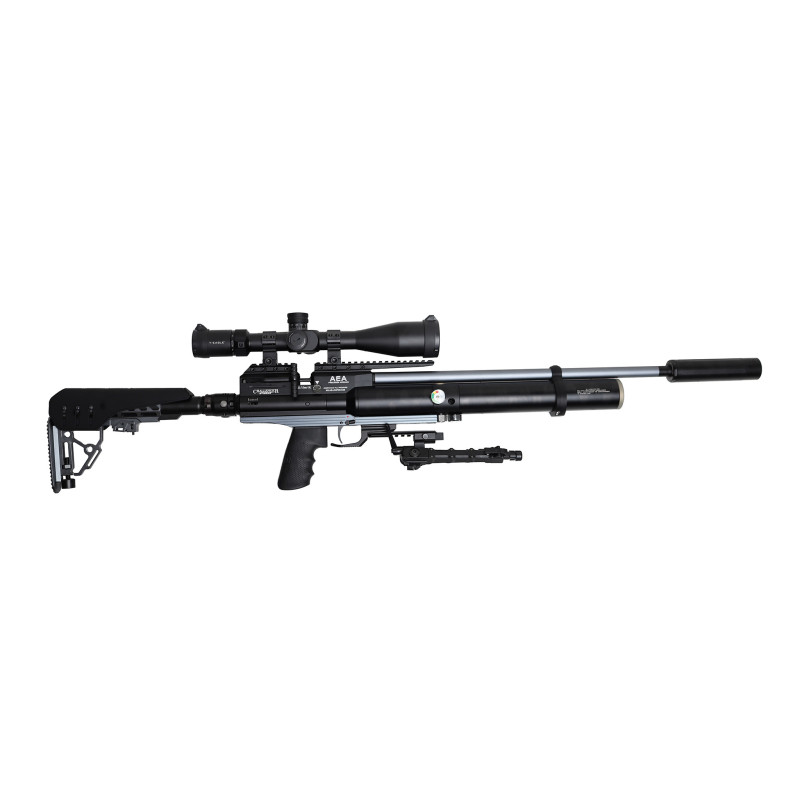
Challenger Pro GEN 3 is a new product that has gained significant popularity in the American market. Its incredible accuracy, power, compactness, and good price make this carbine ideal for anyone who wants to shoot long distances or start their shooting adventure.
Challenger Pro Gen 3 is equipped with a pressure regulator that can be adjusted from the outside using an Allen key.
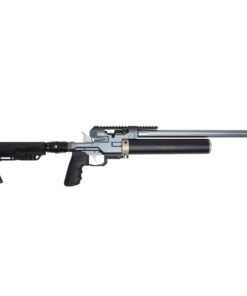
AEA air rifles are famous for their high-quality workmanship. Individual parts are made on CNC machines. All parts fit together very well. The air gun is very compact and light. Its total length is only 93 cm, and after folding the stock it is only less than 68 cm, which means that the air gun can be hidden in a backpack. The weight of the air gun is about 3.5 kg, so we can easily shoot it with a free hand or with a support. The telescopic stock folds to the side and is made of aluminum. We can extend and hide it, and raise and lower the sidebar, thanks to which we can perfectly adjust it to our height to make shooting as comfortable as possible.
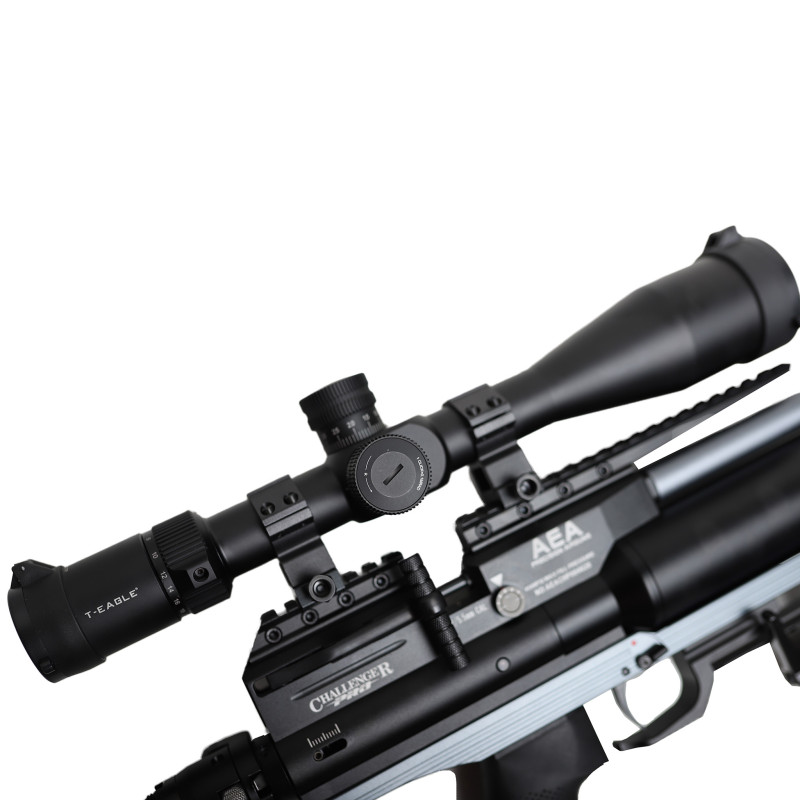
The Challenger Pro air rifle is equipped with a 22 mm standard weaver rail, thanks to which we can mount a scope or a kolimator that will enable quick, accurate shots. Additionally, the lower rail allows the installation of a bipod, which will make shooting from a sitting or lying position more enjoyable.
The carbine is equipped with a large cylinder with a capacity of 330cc and a maximum working pressure of 310 Bar and two pressure gauges, and additionally has a factory externally controlled regulator with POWER PLENUM with a capacity of 120cc, which makes all shots repeatable and with the same muzzle velocity.
The two pressure gauges installed in the cartridge are pressure gauges showing the pressure in the cartridge and on the regulator.
The first pressure gauge, at the bottom of the cartridge, shows the pressure on the cartridge (maximum pressure 310Bar)
The second pressure gauge, next to the cartridge, next to the cartridge filling socket, is responsible for the pressure indication on the regulator and is set from 80 to 170 Bar. As the pressure on the regulator increases, the muzzle velocity and energy of the air gun increase.
The pressure regulator, which is controlled externally, allows us to change the pressure without the need to unscrew the carabiner or release the pressure from the cartridge.
The Allen screw, which is located under the cartridge and the pressure gauge above it, is a screw that allows you to change the pressure on the regulator.
Increasing the pressure on the regulator is done by slowly turning the screw from left to right, you will see increasing pressure on the pressure gauge from the regulator and a quiet hissing sound.
Reducing the pressure on the regulator is done by slowly turning the screw from right to left. Please remember that we will not see the readings on the pressure gauge immediately!!! After lowering the pressure, you need to shoot “dry” a few times (without pellets) so that our regulator and the O-rings inside the regulator are in place. After a few shots, you will see a reduced value on the pressure gauge, if it is insufficient, repeat the operation.
It is very important that when lowering and increasing the pressure on the regulator, you do it slowly and do not turn the screw too aggressively.
Number of shots on one tank:
Challenger Pro is equipped with muzzle velocity adjustments. The muzzle velocity adjustment wheel is located near the magazine, and we can very easily replace it with another one with a larger or smaller through-bore diameter from the transfer port, or by turning the wheel, we can change the muzzle velocity parameters.
Olso we can adjustment muzzle speed use Hammer spring. if we folding our Stock, we will see scrow for allen key and we can regulate hammer spring using the key.
Barrel 24 inches (61 cm) long and thread pitch:
Makes AEA rifles great at shooting slug bullets. The 14×1 thread at the outlet allows you to screw on an additional silencer, or you can screw on an adapter A99 from DONNY FL and you will be able to use 1/2 UNF silencers, or use moderator Ronin DonnyFl with Special adapter for thread 14×1.
The magazines are made very carefully so as not to damage the pellets or pellets during indexing. The magazine capacity varies depending on the caliber:
| Available Calibers | .22(5,5mm) / .25(6,35mm) / .30(7,62mm) / .357(9mm) |
| Barrel Length | 24″ (62cm) |
| Maximum Energy | .22(5,5mm)- 98Joules / .25(6.35mm)-125Joules / .30 (7,62mm)- 180Joules / .357(9mm)- 240Joules |
| Air Cylinder | 350 cc, working pressure 310bar |
| Power Plenum | 170 cc |
| Regulator | external regulator adjustable 80–170bar |
| Magazine Capacity | .22(5,5mm)- 12slots / .25(6.35mm)- 10slots / .30 (7,62mm)- 9slots / .357(9mm)- 8slots |
| Adjustments | Transfer port, velocity wheel, hammer tension (Plus / Minus), Regulator |
| Rails | Upper Weaver 22 mm rail (scope / red dot), extended lower rail 22mm (bipod) |
| Stock | Aluminium, telescopic, side-folding; adjustable length of pull and cheek rest |
| Overall Length | 93cm (68cm folded) |
| Weight | 3.5 kg (without optics) |
| Safety | Manual, ambidextrous |
* The maximum values given above apply to FAC air rifles (without energy limit).
** Muzzle velocity may vary depending on the weight and shape of the pellets
Presented as a complete, ready-to-use precision PCP air rifle package that is engineered for accuracy, power, and field readiness.
This carefully curated set is designed so that exceptional long-range performance, tactical stability, and quiet operation are delivered straight from the box. Popularity has been gained rapidly in demanding markets because outstanding consistency, compact dimensions, and versatile power options are combined in one accessible package. Consequently, both experienced precision shooters and those beginning their journey are welcomed by its inclusive design and adjustable features.
Moreover, the full keyphrase configuration ensures that every essential accessory is matched for immediate effectiveness, allowing focused practice or field use without additional sourcing.
The complete package is assembled with the following carefully selected components:
In addition, the bundle is configured so that mounting, sighting, support, and sound moderation are already integrated, eliminating the usual delays of piecemeal assembly.
A substantial air cylinder (approximately 330–350 cc capacity) with a working pressure of up to 310 bar is fitted, while dual pressure gauges are provided for clear monitoring. Furthermore, an externally adjustable regulator (typically 80–170 bar) is paired with a generous power plenum (around 150–170 cc). As a result, shot-to-shot velocity consistency is maintained across a full fill, and reliable performance is delivered even during extended sessions.
Velocity adjustment is enabled through a convenient transfer-port wheel located near the magazine, and additional fine-tuning of hammer-spring tension is made accessible when the stock is folded. Therefore, power levels can be tailored for different pellet or slug weights and for local energy regulations without internal disassembly.
A 24-inch (approximately 61–62 cm) barrel is utilized, featuring optimized twist rates (commonly 1:17.7 for .22/.25 and 1:16 for .30) that support both traditional pellets and heavier slug projectiles. Consequently, excellent grouping potential is achieved at extended distances. A 14×1 muzzle thread is provided, allowing the included Ronin silencer (or compatible alternatives via adapters) to be attached securely.
Caliber options typically encompass .22 (5.5 mm), .25 (6.35 mm), .30 (7.62 mm), and .357 (9 mm), with corresponding magazine capacities of 12, 10, 9, and 8 rounds. Maximum energy figures (FAC versions) can reach impressive levels depending on caliber, while regulated versions suitable for restricted markets are also supported. In this way, a wide range of shooting disciplines—from target work to pest control—is accommodated.
An aluminum telescopic, side-folding stock is incorporated, offering adjustable length of pull and cheek-rest height. Overall length measures approximately 93 cm when extended and folds to roughly 68 cm (or less in some configurations), while unloaded weight remains near 3.5 kg. Therefore, the rifle can be carried discreetly in a backpack yet remains stable and comfortable during prolonged use.
An ambidextrous manual safety and an adjustable two-stage trigger are fitted, ensuring that left- and right-handed shooters of varying experience levels are equally well served. Upper and lower Weaver/Picatinny-style rails (22 mm) are standard, facilitating secure mounting of the supplied optics and bipod.
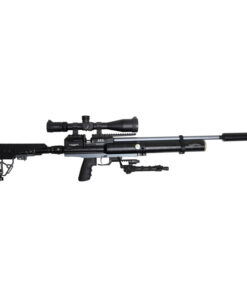
Precise aiming is elevated by the included first-focal-plane T-Eagle scope. Holdover and ranging markings remain accurate across the full magnification range, while illumination assists performance in changing light. Consequently, confident target engagement is supported from close to long-range distances when the scope is properly zeroed on the Weaver rail.
Stable shooting positions are enabled by the V9 PRO bipod. Adjustable leg heights and a quick-detach or secure mounting interface allow rapid deployment for prone or supported positions. As a result, wobble is minimized and group sizes are tightened, particularly during precision sessions or field observation.
Sound signature is significantly reduced by the Ronin silencer (paired with the appropriate adapter). Quieter operation is achieved without compromising the rifle’s inherent accuracy or power potential. Therefore, backyard-friendly practice or discreet field use becomes far more practical, while neighbor considerations and personal comfort are respected.
Outstanding accuracy potential is combined with high shot counts per fill (often 50+ in smaller calibers at moderate power settings). Moreover, the modular nature of the platform invites further personalization through additional rails, optics, or accessories.
Inclusive language and features are prioritized: the ambidextrous safety, fully adjustable stock, and straightforward controls welcome shooters of different body types, handedness, and experience levels. Transition from plinking to serious long-range work is smoothed by the consistent regulator and versatile power adjustments. In addition, the complete bundle approach removes barriers that often discourage newcomers, while still satisfying the demands of advanced users seeking a reliable tactical-style PCP.
Compact dimensions further enhance portability, so the setup can be transported easily yet delivers match-grade potential when deployed. Energy efficiency and repeatability are maintained across the regulator’s range, supporting both high-power slug shooting and lower-power practice with the same platform.
Value is maximized because premium matching components are already selected and included. Time that would otherwise be spent researching and purchasing separate scopes, bipods, and moderators is saved. Furthermore, the AEA reputation for CNC-machined durability and practical field performance is leveraged throughout the package.
Whether the goal is competitive-style precision, recreational target shooting, or effective pest management, the system is ready. Consistency is delivered by the regulated air system; clarity is provided by the FFP optic; support is offered by the bipod; and discretion is added by the silencer. Consequently, focus remains on the shot rather than on equipment gaps.
Technical highlights that reinforce reliability include the external regulator access, dual gauges, quality magazines designed to protect projectiles, and the robust aluminum construction of critical components. Shot-to-shot variation is kept low, and the platform responds well to careful tuning of the transfer port and hammer spring.
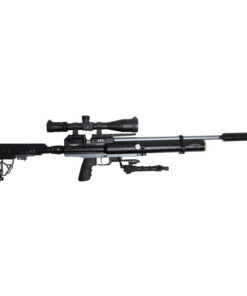
The AEA AIRGUN Challenger Pro Gen 3 Bundle with Scope T-eagle, Bipod v9 & Silencer Ronin is configured so that setup time is minimized and shooting enjoyment begins promptly. All major elements required for accurate, stable, and quieter performance are already present.
Careful inspection of local regulations regarding energy levels, licensing, and use is always recommended before operation. Proper zeroing of the scope, correct fill pressure, and safe handling practices further ensure that the full potential of the package is realized safely and enjoyably by every user.
This complete solution invites shooters at every stage to experience the precision, power, and practicality that have made the Challenger Pro Gen 3 platform a standout choice. The bundle is therefore positioned as an efficient path toward consistent results and lasting satisfaction on the range or in the field.
.
The modern airgun market has continued to evolve with powerful PCP platforms, tactical designs, and innovative compressed-air systems. Among the most discussed names are Bintac, Bintac LLC, Bintacllc, and Bin Tac, with products such as the Bintac T9, Bintac T 50, Bintac T50, Bintac M50, Bintac MCAR, and Bintac S45 attracting attention from shooting enthusiasts searching for advanced performance, unique designs, and reliable air-powered technology. The Bintac T9 has become a popular topic among users looking for information about the Bintac T9 price, Bintac T9 full auto configurations, Bintac T9 Amazon availability, and overall performance expectations. Likewise, the Bintac T50, Bintac T50 Extreme, and AEA Bintac T50 Extreme are frequently researched by those interested in high-power PCP air rifles.
The Bintac AEA Harpoon platform represents one of the most recognizable large-caliber airgun systems available today. Searches for Bintac AEA Harpoon, AEA Harpoon, AEA Harpoon for sale, AEA Harpoon price, AEA Harpoon Magnum, AEA Harpoon Gun, AEA Harpoon Air Gun, AEA Harpoon cartridge, AEA .50 Harpoon, AA Harpoon, and harpoon air gun demonstrate strong interest in powerful air-powered designs. The AEA Harpoon is often compared with other premium large-caliber platforms, including the Megalodon air rifle, AEA Megalodon, AEA Megalodon air rifle, AEA Megalodon 58 cal, AEA Megalodon .58 cal, AEA Megalodon 50 caliber, AEA Megalodon 50 cal price, and AEA Megalodon for sale options.
The Bintac family includes different models designed for various shooting preferences. The Bintac M50, Bintac M50 pistol, Bintac M50 pump action, and Bintac M50 for sale searches are commonly associated with compact yet powerful PCP platforms. The Bintac MCAR air rifle, Bintac MCAR, and Bintac MCAR 457 are also popular among users searching for tactical-style air rifles. In addition, the Bintac S45 and Bintac S45 for sale listings attract buyers interested in alternative configurations within the Bintac range.
AEA Airguns has developed a reputation for producing innovative high-performance airgun systems. Models such as the AEA Defender, AEA Defender 2, AEA Defender 3, AEA Terminator, and AEA Terminator Gen 3 are frequently compared with other powerful PCP platforms. AEA guns continue to attract attention because of their combination of power, engineering, and unique operating systems. Buyers researching air tank for PCP airguns, anti air tanks, air powered 50 cal rifle platforms, automatic air gun systems, airgun shotgun designs, and advanced PCP technology often compare AEA Airguns models with other manufacturers.
Large-caliber airguns have created a growing market for specialized shooting platforms. Products and searches related to the Zeus 72 cal air rifle price, bee bee gun rifle, compressed air systems, and high-performance PCP rifles show increasing interest in powerful alternatives to traditional firearms. Users exploring pcp air rifles, pcp rifles, air rifle pcp, and precision air platforms often compare different brands based on accuracy, air capacity, reliability, and intended application.
The wider airgun industry also includes respected manufacturers such as Kral Arms and related platforms. Kral Arms, Kral, Krql, Kr Al, and الكرال are recognized names among enthusiasts searching for affordable and capable PCP systems. Models including the Kral NP 02, Kral Puncher, Kral Breaker Puncher, Kral Puncher K, Puncher Mega, Shadow Puncher, Shadow Puncher, Puncher Auto, Kral Pump, and Kral Breaker Puncher provide different options for users interested in tactical and sporting air rifles.
Kral-related searches such as Kral Arms, Krale wholesale, Kroll firearms, and other international airgun suppliers demonstrate the global demand for PCP technology. Other related models and categories include Bigmax, TacticalX, Tacticalx, Tactical Tundra, Empirex, Raptor S, AKR gun, King Arms Fal, Kalibre pistol, Kora gun, Kar gun, NP500, KP12, ST 500, Dazzle S, and additional tactical shooting platforms.
The market also includes firearm-style search categories and international terminology such as 223 rifle, 223 guns, 223 arma, rifle cal 22 semiautomatico, av tüfeği, tabancalar, inertia shotguns, shotgun XM, XM shotgun, A12 shotgun, 410 shotgun semi auto magazine fed, and other shooting equipment categories. These terms represent the broad interest surrounding modern shooting technology, including PCP rifles, tactical platforms, magazine-fed systems, and precision air-powered designs.
Calibres, FAC Options, Power Delivery and Compatible Accessories for the AEA AIRGUN Challenger Pro Gen 3
The AEA AIRGUN Challenger Pro Gen 3 is engineered so that a broad spectrum of shooting requirements is met through carefully selected calibre choices, flexible power configurations and a wide ecosystem of supporting accessories. Consequently, both restricted-energy markets and full-power FAC users are accommodated within the same proven platform. Moreover, the modular design ensures that performance can be tailored while remaining inclusive for shooters of differing experience levels and physical preferences.
Four primary calibres are offered, each optimised for specific projectile types and intended applications.
In each case the 24-inch barrel length contributes to consistent velocity and grouping potential. Furthermore, the external regulator and adjustable transfer port allow the same rifle body to be fine-tuned for the chosen calibre, ensuring that shot-to-shot consistency remains high regardless of the projectile selected. Inclusive ergonomics—adjustable length of pull, cheek height and ambidextrous safety—mean that left- and right-handed users of varying stature can extract the full benefit of any calibre without compromise.
Full-power FAC versions of the AEA AIRGUN Challenger Pro Gen 3 are supplied without artificial energy limiters, unlocking the platform’s maximum capability. Approximate maximum energies commonly quoted for FAC examples are:
These figures are achieved when the regulator, transfer port and hammer-spring tension are set appropriately and suitable projectiles are used. Velocity and energy will of course vary with pellet or slug weight, ambient temperature and fill pressure, yet the large air cylinder (approximately 330–350 cc) and substantial power plenum (150–170 cc range) provide the reservoir needed for impressive shot strings even at elevated power levels.
For markets subject to energy restrictions, regulated or limited versions are available. These are typically declared at or below 16 J or 17 J (depending on local legislation) and are supplied with the appropriate documentation. The same external regulator (adjustable across roughly 80–170 bar) and transfer-port wheel remain fully functional, allowing users to dial power downward for backyard practice or upward within legal limits. Consequently, a single platform can serve both recreational and more demanding roles simply by changing settings or selecting the correct factory configuration.
Power delivery itself is characterised by excellent consistency. The regulated system maintains stable muzzle velocity across a substantial portion of the air fill, while dual pressure gauges give clear visual feedback. Additional fine-tuning is possible via the hammer-spring adjustment accessible when the stock is folded, giving shooters further control without the need for extensive internal work. Shot counts per fill typically remain generous—often 50-plus in the smaller calibres at moderate settings and still practical numbers even in the larger, higher-energy configurations.
A rich accessory ecosystem surrounds the Challenger Pro Gen 3, extending the rifle’s versatility long after the initial purchase. The factory bundle already includes the T-Eagle 6-24×50 FFP MRAD scope, V9 PRO bipod and Ronin silencer with adapter, yet many further options enhance or specialise the setup.
Optics and Mounting Additional or alternative scopes, red-dot sights and thermal or night-vision devices can be mounted on the upper 22 mm Weaver rail. Quick-detach rings or cantilever mounts are commonly employed so that zero can be preserved when optics are swapped. Lower rails accept bipods, lights or other tactical attachments.
Sound Moderation and Muzzle Devices Beyond the included Ronin, further moderators can be fitted via the 14×1 muzzle thread or through readily available adapters (including ½-UNF options). Different baffle designs or carbon-fibre units allow users to prioritise maximum quietness, weight reduction or a specific aesthetic.
Support and Stability The V9 PRO bipod is already supplied, yet alternative bipods, monopods or shooting rests that interface with the lower rail or ARCA-compatible sections can be added. For benchrest or extreme precision work, heavier rests or bags are frequently paired with the rifle.
Magazines, Projectiles and Filling Extra magazines matched to each calibre are widely available and recommended for extended sessions. High-quality pellets and slugs suited to the chosen twist rate further unlock accuracy potential. Fill probes, quick-connect fittings and larger air tanks or compressors complete the air-supply chain, while pressure gauges and chronographs assist with precise tuning.
Stock and Ergonomic Upgrades Although the aluminium telescopic, side-folding stock is already highly adjustable, aftermarket cheek risers, butt pads or grip enhancements can be fitted by users seeking a more personalised interface. The compact folded length (approximately 68 cm or less) remains a major advantage for transport regardless of additional accessories.
Protective and Practical Items Hard cases, soft gun bags, lens covers, cleaning kits and spare seals or O-rings are practical additions that protect the investment and maintain reliability over years of use. Because the platform is modular, many of these items can be added progressively as shooting interests evolve.
Taken together, the calibre choices, FAC or regulated power options and extensive accessory compatibility make the AEA AIRGUN Challenger Pro Gen 3 an adaptable foundation rather than a fixed solution. Whether the priority is legal compliance in restricted jurisdictions, maximum energy for FAC holders, or simply the ability to reconfigure the same rifle for different disciplines, the necessary flexibility is built in. Inclusive design features ensure that these capabilities remain accessible to a wide community of shooters, while the robust construction and consistent air delivery support both casual enjoyment and serious performance goals.
Selecting the appropriate calibre, confirming the correct power specification for local regulations, and adding only the accessories that match individual needs will allow the full potential of the platform to be realised safely and effectively.
Frequently Asked Questions
The ready-to-shoot package contains the precision PCP air rifle itself, a high-quality first-focal-plane riflescope with 6-24× magnification and a 50 mm objective, a tactical bipod designed for stable support, and a sound moderator with the appropriate adapter. Two magazines matched to the selected calibre, a fill probe, a full-power transfer port option, and supporting documentation are also supplied. This combination is assembled so that the essential elements for accurate, supported and quieter shooting are present from the first outing. Additional items such as extra magazines or alternative optics can be added later according to individual preference, yet the core set already removes the need for immediate further purchases.
Four calibres are offered to cover a wide range of applications. The .22 option prioritises efficiency, high shot counts and excellent precision with both pellets and lighter slugs. The .25 provides a noticeable increase in energy while remaining practical for extended sessions. The .30 is preferred when heavier projectiles and stronger terminal performance are desired, and the largest .357 delivers the highest energy potential within the platform. Each calibre uses a magazine capacity suited to its size—twelve, ten, nine or eight rounds respectively—and benefits from a barrel twist rate optimised for stability. Shooters of every experience level can therefore select the calibre that best matches their typical distances, projectile preference and local regulations without changing the fundamental handling characteristics of the rifle.
Yes. Versions without energy limiters are produced for markets that permit higher power levels. These configurations allow the platform to reach its maximum potential when the regulator, transfer port and hammer-spring settings are adjusted accordingly. Approximate peak energies scale with calibre, offering substantial figures in the larger sizes while still maintaining the consistency that characterises the regulated air system. Prospective owners should always verify current local legislation and licensing requirements before selecting a full-power configuration. The same external adjustments that enable high output also allow the power to be reduced for practice or for compliance with temporary restrictions.
Power is managed through a combination of an externally accessible regulator, a velocity-adjustment wheel located near the magazine, and a hammer-spring tension screw that becomes reachable when the stock is folded. The regulator maintains a stable working pressure across a useful portion of the air fill, while the transfer-port wheel alters the volume of air released for each shot. Fine changes to hammer-spring tension provide a further layer of control. Dual pressure gauges give clear visual confirmation of both reservoir and regulated pressures. Consequently, the same rifle can be tuned for maximum legal energy, for moderated practice sessions, or for optimal performance with a particular projectile weight. The process is straightforward enough that shooters new to regulated PCPs can learn it quickly, while experienced users appreciate the range of fine adjustment available.
Shot count varies with calibre, power setting and projectile weight. In the smaller calibres at moderate regulator settings, fifty or more consistent shots are commonly achieved. Larger calibres or higher power settings naturally reduce the number, yet the substantial air cylinder and generous power plenum still deliver practical strings for most field or range sessions. Consistency remains high throughout the usable portion of the fill because the regulator isolates the firing valve from the declining reservoir pressure. Monitoring the gauges and recharging before velocity begins to drop ensures that every shot stays within the desired performance window.
Overall length measures approximately ninety-three centimetres with the stock extended. When the side-folding stock is collapsed the package becomes significantly more compact, typically around sixty-eight centimetres or less, allowing it to fit comfortably into many backpacks or cases. Unloaded weight without optics sits near three and a half kilograms. The aluminium telescopic stock is adjustable for length of pull and cheek height, so the balance and fit can be tailored to different body sizes and shooting positions. These dimensions make the platform practical for transport while still providing a stable platform once deployed.
Practical Use Scenarios
Everyday ownership becomes meaningful when the equipment is applied in real conditions rather than remaining in a case. The following scenarios illustrate how the combination of a regulated precision platform, clear magnified optics, stable support and effective sound reduction works together across common shooting activities. Each situation highlights the practical advantages of consistent power delivery, adjustable ergonomics and rapid readiness, while remaining accessible to shooters of varying experience and physical build.
A typical range day begins with a short walk from the vehicle. The compact folded length allows the complete setup to be carried in a modest backpack alongside a small air tank, a chronograph and a selection of projectiles. Once at the bench or designated firing point the stock is unfolded, length of pull and cheek height are set to the individual shooter, and the bipod legs are extended to create a level platform on the mat or table.
The first-focal-plane optic is already mounted and has retained its zero from the previous outing. Magnification is adjusted to the distance of the first target—perhaps fifty metres for initial confirmation—while the reticle subtensions remain accurate. A few sighters are fired at a moderate regulator setting. Velocity is checked on the chronograph and, if necessary, the transfer-port wheel or hammer-spring tension is altered by a small amount so that the desired impact velocity is achieved. Because the air system is regulated, subsequent shots stay within a tight velocity band, allowing groups to be assessed with confidence rather than being masked by power variation.
After the primary zero is confirmed, magnification is increased and targets at seventy-five and one hundred metres are engaged. The bipod keeps the rifle steady during the longer holds, reducing muscle tremor that would otherwise open groups. Between strings the dual pressure gauges are monitored so that the reservoir is refilled before the regulated plateau begins to drop. The entire process remains quiet enough that neighbouring lanes are not disturbed, and the session can continue for an hour or more without fatigue caused by excessive report or recoil.
Shooters who share equipment find the adjustable stock and ambidextrous safety particularly useful; each person can quickly tailor the fit before taking their turn. By the end of the morning a clear picture of point-of-impact shift with different projectiles has been established, and the data is recorded for future reference.
When the task moves from the formal range to open farmland or orchard margins, portability and discretion become central. The folded package slips into a soft case or backpack and is carried across uneven ground without drawing attention. Upon reaching a suitable observation point the stock is extended, the bipod is deployed, and the optic is used to scan for activity at ranges that may vary from thirty to eighty metres or more.
Power is often reduced slightly from the maximum available setting so that the report remains subdued and the risk of over-penetration is minimised. The sound moderator further softens the signature, allowing several opportunities to be taken without immediately alerting remaining animals. Because the regulator maintains consistent velocity, the hold-over marks on the reticle can be trusted from one shot to the next even as the air supply slowly declines.
The moderate overall weight and balanced design make unsupported or lightly supported shots practical when the bipod cannot be used— for example when shooting from a kneeling position beside a hedge or from the window of a parked vehicle. An adjustable cheek piece ensures that the eye aligns naturally with the optic regardless of the awkward stance. After each successful engagement the area is observed for a short period; the quiet operation helps preserve the natural behaviour of remaining targets.
| Caliber | .22, .25, .30, .357 |
|---|
AEA AIRGUN
AEA AIRGUN
Calibers: Most common are .177 (4.5mm) for speed/flat trajectory and general use, and .22 (5.5mm) for better hunting knockdown power. Larger “big bore” (.25, .30, .357+) exist for hunting bigger game where legal.
Yes, many modern PCP and springers deliver enough energy for small game (rabbits, squirrels, birds) and even larger game in some areas. Muzzle energy (in ft-lbs or joules) matters more than velocity alone. Always match caliber, pellet weight, and energy to the game and check local hunting regs.
Treat every airgun as if it is loaded.
Follow these rules strictly—airguns cause real injuries.
Laws differ dramatically by country, state/province, and even city. Always verify current local laws before buying, owning, transporting, or using an airgun. Age restrictions (often 18+) are common.
Examples (summaries only; check official sources):
Resources: Wikipedia “Air gun laws”, airgun forums, or official government sites. For travel, research transit laws carefully.
Consider:
Buy from reputable dealers and consider warranties.
Follow your model’s manual. Basic care extends life significantly.
International shipping may be available for select products. Customers are responsible for understanding and complying with their local import laws and regulations before ordering.
Yes. Customers are required to confirm their order number through WhatsApp or Live Chat before orders are processed and shipped.
If local laws prevent shipment to your area, your order may be canceled and refunded according to our store policy.
Processing typically takes 1–3 business days after payment confirmation. Delivery times vary depending on destination, carrier, and product availability.
Pellets are the most common projectile (lead or lead-free). Match them to your gun, caliber, and purpose—test several brands as accuracy varies by barrel.
Tips: Heavier pellets in .22/.25 for hunting (better momentum). Lighter in .177 for speed/flat trajectory. Always check head size fit (e.g., 4.51-4.53mm variants).
Muzzle energy (ft-lbs or joules) matters more than velocity. Ethical shots require precise placement (head/heart-lung) within effective range.
Rough Guidelines (adjust for distance, pellet, and local laws):
PCPs dominate serious hunting due to power and shot count. Springers/gas rams work well for small game but require skill. Always prioritize clean kills and check seasons/species rules.
Common Issues:
Toggle Content
Budget Tip: Start with a quality springer (~$150-400) before investing in PCP setup.
Airgunning offers endless depth—from backyard plinking to precision competition and ethical hunting. Prioritize safety, legality, and practice. If you want specifics (e.g., recommendations for a country, budget, hunting small game, or a particular type like PCP vs springer), let me know for more targeted info! Shoot responsibly.
Tuning improves accuracy, reduces noise/recoil, or increases power (within legal limits).
Caution: Check laws—power increases may reclassify your gun. DIY only if experienced; professional tuners recommended.
You must be at least 18 years old to purchase any airgun or related accessories from our store. By placing an order, you confirm that you meet the legal age requirements in your state or country.
Yes. Orders may require age verification before processing and shipping. In some cases, we may request a valid government-issued ID to confirm eligibility.
WhatsApp us



Reviews
There are no reviews yet.